How to Optimize a Matmul Kernel with Croqtile: a Worklog
April 2026 · GPU: NVIDIA H800 PCIe (SM90a) · Precision: FP16 · Problem: 8192×8192×8192
In this worklog I start from the most naive possible matrix multiplication and step-by-step apply every major GPU optimization technique until the kernel exceeds cuBLAS — all in a high-level DSL called Croqtile. The finished kernel is 60 lines. No hand-written CUDA, no PTX intrinsics, no manual thread-index arithmetic.
This is a companion piece to Simon Boehm's excellent CUDA MMM worklog, but the angle is different: instead of showing the low-level details, I want to show how a well-designed kernel DSL can express the same optimizations cleanly — which means you understand what you are doing without losing half a week on how to say it in code.
Download source code
All kernel files from this tutorial are available as a single archive: matmul_tutorial_kernels.tar.gz
Compile and run any kernel:
croqtile -gs -t cute -arch=sm_90a kernel.co -o kernel.cute.result
bash kernel.cute.result --execute
Performance at a glance
| Kernel | Time (ms) | TFLOPS | % of cuBLAS |
|---|---|---|---|
| v0: Naive | ~2890 | 0.38 | 0.08% |
| v1: Shared memory | ~728 | 1.51 | 0.34% |
| v2: Hopper TMA + WGMMA | 3.87 | 284.4 | 63.6% |
| v3: Warp specialization | 3.81 | 288.3 | 64.4% |
| v4: Production-tuned | 2.24 | 489.9 | 109.5% |
| cuBLAS (reference) | 2.46 | 447.5 | 100.0% |
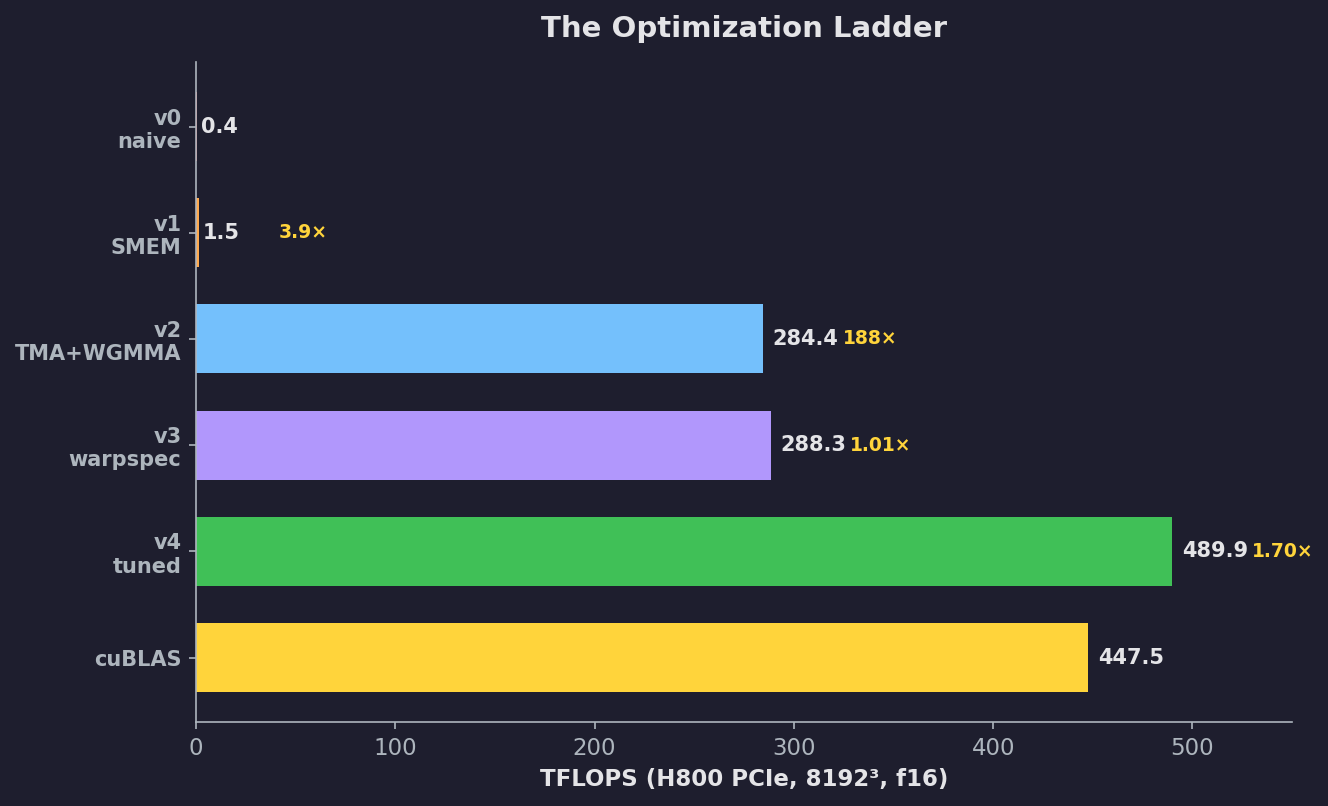
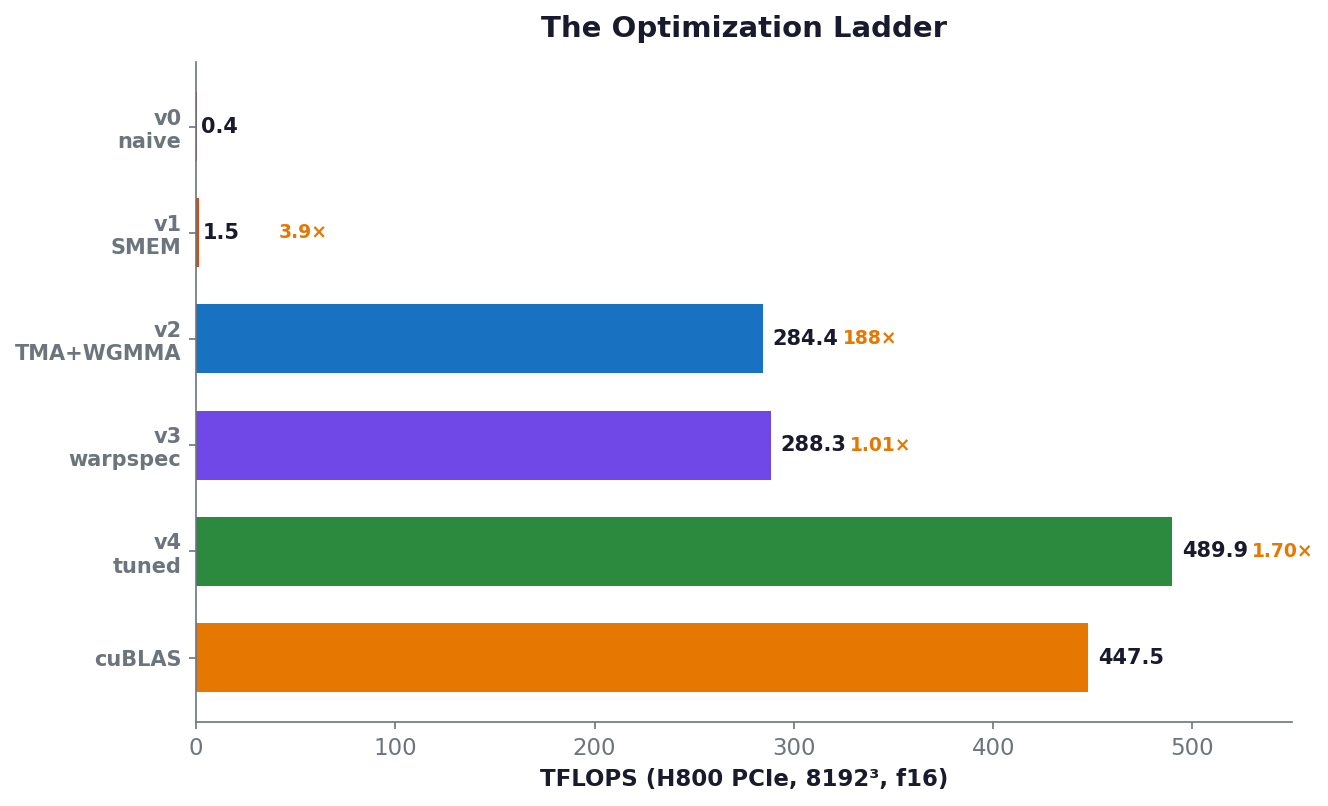
1289× improvement from v0 to v4 in five steps. Let's see how each one works.
Kernel 0: Naive
File: matmul_f16_v0_naive.co
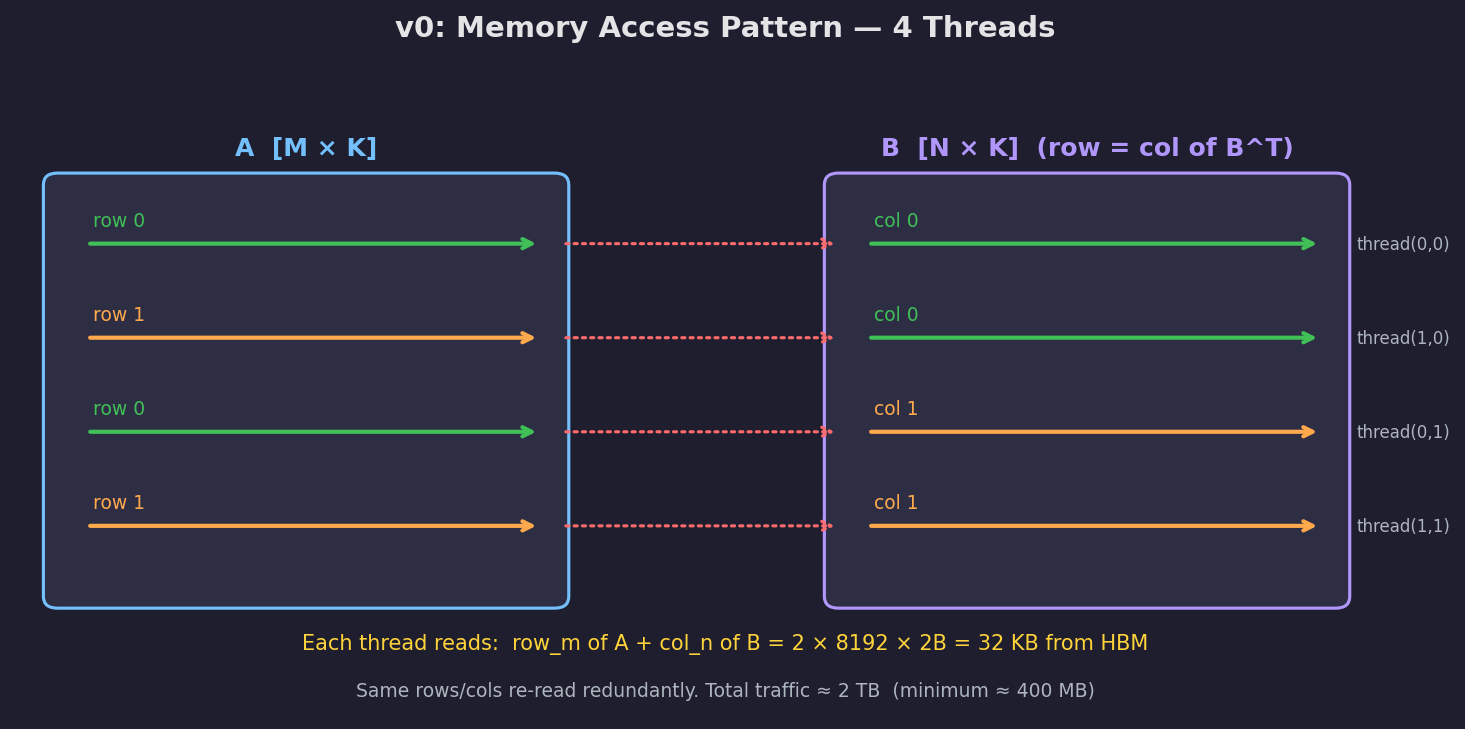
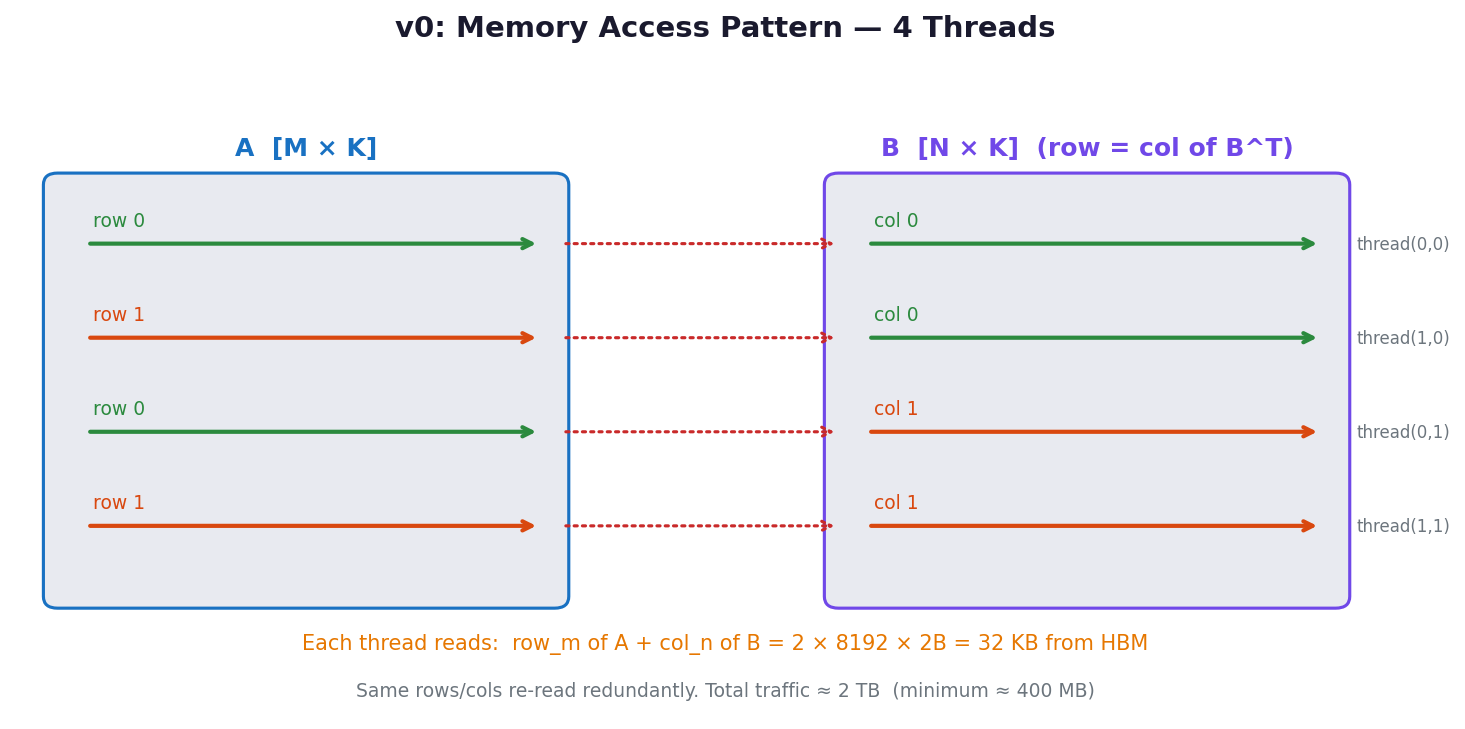
The simplest possible formulation: one thread owns one output element and independently reads a full row of A and column of B from global memory.
// TILE_M = 32, TILE_N = 32
// 32×32 = 1024 threads per block.

__co__ void matmul(
    global f16 [M, K] lhs,
    global f16 [N, K] rhs,
    global f16 [M, N] output) {
  parallel {block_m, block_n} by [cdiv(M, TILE_M), cdiv(N, TILE_N)] : block,
           {thr_m, thr_n} by [TILE_M, TILE_N] : thread {
    f16 acc = 0.0f;
    foreach {iv_k} in [K]
      acc += lhs.at(block_m#thr_m, iv_k) * rhs.at(block_n#thr_n, iv_k);

    output.at(block_m#thr_m, block_n#thr_n) = acc;
  }
}
Croqtile concepts introduced here:
| Construct | Meaning |
|---|---|
global f16 [M, K] lhs |
A tensor in GPU global memory (HBM). Shape is symbolic; Croqtile infers strides. |
parallel {i,j} by [X,Y] : block |
Create a 2-D grid of thread-blocks of size X×Y. i and j are block-level indices. |
parallel {i,j} by [X,Y] : thread |
Create X×Y threads inside each block. Composes with the enclosing block partition. |
block_m # thr_m |
The # operator composes two parallel indices into one flat index: block_m * TILE_M + thr_m. |
foreach {iv_k} in [K] |
A plain sequential loop — no parallelism, no reordering. |
.at(i, j) |
Element-level accessor into a 2-D tensor. |
Generated CUDA (v0)
parallel : block / : thread become blockIdx / threadIdx arithmetic. The # composition becomes a multiply-add. The whole kernel is just a loop:
__global__ void matmul_kernel(f16* lhs, f16* rhs, f16* output,
                               unsigned K, unsigned M, unsigned N) {
  int thr_m = threadIdx.x / 32, thr_n = threadIdx.x % 32;

  f16 acc = 0.0f;
  for (int k = 0; k < K; ++k)
    acc = acc + lhs[(blockIdx.x * 32 + thr_m) * K + k]
              * rhs[(blockIdx.y * 32 + thr_n) * K + k];

  output[(blockIdx.x * 32 + thr_m) * N + (blockIdx.y * 32 + thr_n)] = acc;
}
// dim3 grid((M+31)/32, (N+31)/32, 1), block(1024, 1, 1);
NCU snapshot (v0)
dram__throughput (% of peak HBM BW) :   0.01%
sm__throughput   (% of peak SM)     :   5.99%
pipe_tensor instructions            :   0          ← tensor cores completely idle
pipe_fma  instructions              :   336,592,896
The access pattern is so scattered that the hardware serialises HBM requests instead of coalescing them. HBM throughput is near zero even though every thread is constantly reading.
Result: ~0.38 TFLOPS (0.08% of cuBLAS)
Kernel 1: Shared Memory Cache-Blocking
File: matmul_f16_v1_shared_memory.co
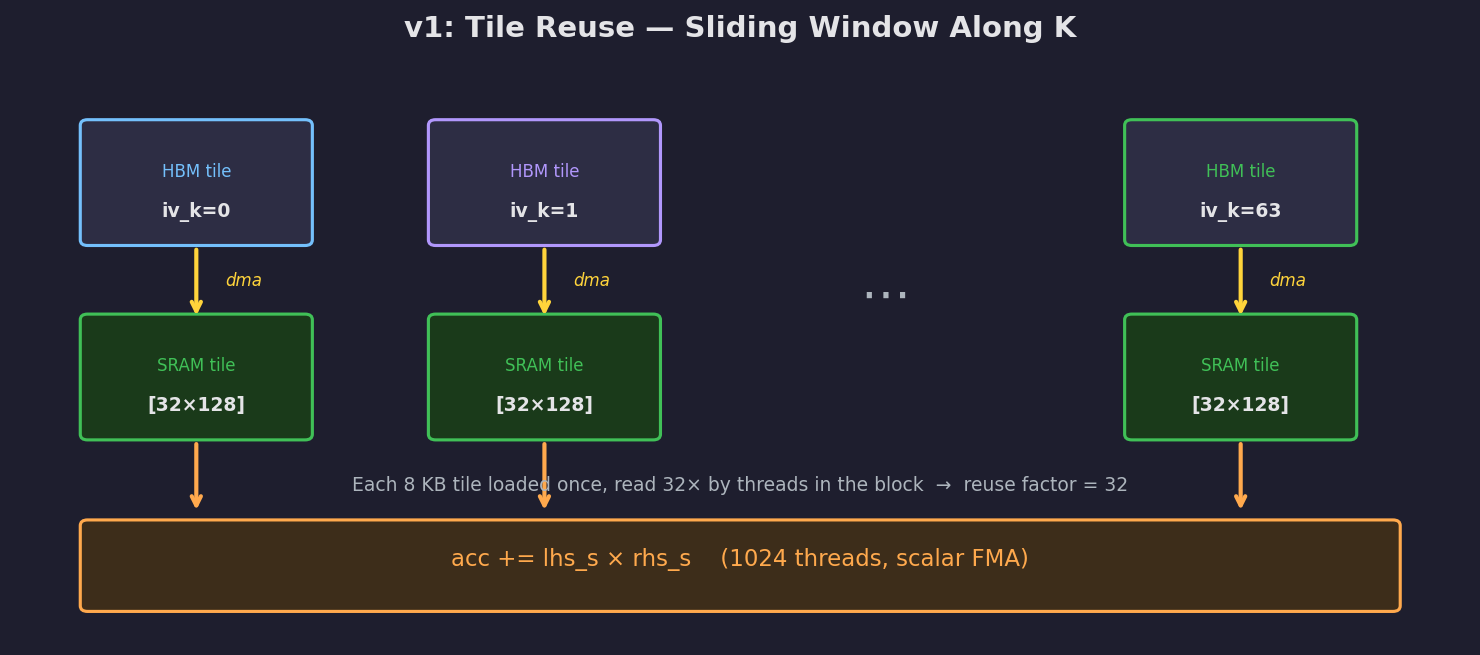
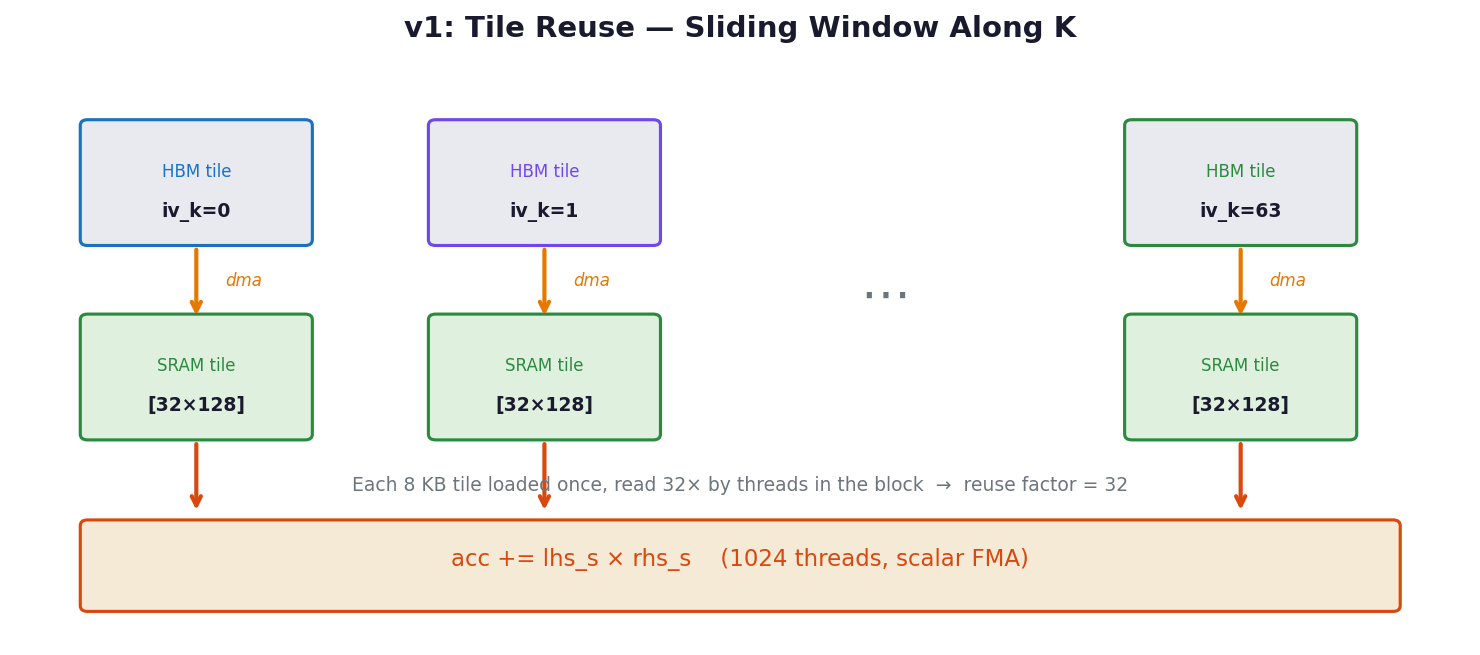
The classic fix: load a tile of A and B into fast on-chip shared memory (SRAM), let all threads in the block reuse that tile, then slide the tile along the K dimension.
// TILE_M = TILE_N = 32, TILE_K = 128

__co__ void matmul(
    global f16 [M, K] lhs,
    global f16 [N, K] rhs,
    global f16 [M, N] output) {
  parallel {block_m, block_n} by [cdiv(M, TILE_M), cdiv(N, TILE_N)] : block,
           {thr_m, thr_n} by [TILE_M, TILE_N] : thread {
    shared f16 [TILE_M, TILE_K] lhs_s;
    shared f16 [TILE_N, TILE_K] rhs_s;
    f16 acc = 0.0f;

    foreach {iv_k} in [cdiv(K, TILE_K)] {
      dma.copy lhs.subspan(TILE_M, TILE_K)
        .at(block_m, iv_k) => lhs_s;
      dma.copy rhs.subspan(TILE_N, TILE_K)
        .at(block_n, iv_k) => rhs_s;

      foreach {ik} in [TILE_K]
        acc += lhs_s.at(thr_m, ik) * rhs_s.at(thr_n, ik);
    }
    output.at(block_m#thr_m, block_n#thr_n) = acc;
  }
}
New concepts:
| Construct | Meaning |
|---|---|
shared f16 [M, K] buf |
Allocates a buffer in on-chip shared memory. Scoped to the block; all threads can read and write it. |
dma.copy src => dst |
Cooperative DMA: all threads in the block collectively transfer src to dst. Croqtile partitions the transfer across threads, generates coalesced loads, and inserts __syncthreads(). One line replaces ~20 lines of manual CUDA. |
.subspan(TILE_M, TILE_K).at(i, j) |
Selects the tile of shape [TILE_M, TILE_K] at grid position (i, j) within the tensor. |
Generated CUDA (v1) — what dma.copy expands to
One line of Croqtile expands to ~25 lines of CUTE layout construction, thread-partitioned copy, and synchronisation. The essential pattern:
// dma.copy ... .at(block_m, iv_k) => lhs_s  →

auto gmem_tile = make_tensor(
    make_gmem_ptr(lhs + ...), make_layout(...));
auto smem_tile = make_tensor(
    make_smem_ptr(lhs_s),     make_layout(...));
auto tiled_copy = make_tiled_copy(
    Copy_Atom<...>{}, thread_layout, val_layout);

cute::copy(tiled_copy,
    thr_copy.partition_S(gmem_tile),  // src slice
    thr_copy.partition_D(smem_tile)); // dst slice
__syncthreads();
Croqtile generates this for both lhs and rhs — two lines become ~50 lines of CUTE.
Scalar FMA units still do the arithmetic — the tensor cores remain idle. The bottleneck has shifted from redundant global loads to the raw compute throughput of scalar FMAs, which are orders of magnitude slower than tensor cores.
Result: ~1.51 TFLOPS (3.9× over v0)
Kernel 2: Hopper TMA + WGMMA
File: matmul_f16_v2_hopper_tma_wgmma.co
The largest single jump: ~188× over v1. Two hardware features specific to Hopper (SM90a) replace both bottlenecks at once:
- TMA (Tensor Memory Accelerator) replaces
dma.copy— data movement becomes a single-thread hardware operation instead of a cooperative thread-wide copy. - WGMMA (Warpgroup MMA) replaces scalar FMA — the compute tile is 64×128×16, executing on dedicated tensor core hardware at throughput orders of magnitude beyond scalar arithmetic.
// WARP_M=64, WARP_N=128, WARP_K=16, TILE_K=64, SWIZ=128

__co__ void matmul(
    global f16 [M, K] lhs,
    global f16 [N, K] rhs,
    global f16 [M, N] output) {
  parallel {block_m, block_n} by [cdiv(M, WARP_M), cdiv(N, WARP_N)] : block,
      by 1 : group-4 {
    shared f16 [WARP_M, TILE_K] lhs_s;
    shared f16 [WARP_N, TILE_K] rhs_s;
    shared f16 [WARP_M, WARP_N] output_s;

    mc = mma.fill.f16 0.0f;
    foreach {iv_k} in [cdiv(K, TILE_K)] {
      tma.copy.swiz<SWIZ> lhs.chunkat(block_m, iv_k) => lhs_s;
      tma.copy.swiz<SWIZ> rhs.chunkat(block_n, iv_k) => rhs_s;

      foreach {iv_wk} in [cdiv(TILE_K, WARP_K)] {
        ma = mma.load.swiz<SWIZ> lhs_s.chunkat(_, iv_wk);
        mb = mma.load.swiz<SWIZ> rhs_s.chunkat(_, iv_wk);
        mma.row.row mc, ma, mb;
      }
    }
    mma.store mc, output_s;
    tma.copy output_s =>
      output.subspan(WARP_M, WARP_N)
        .at(block_m, block_n);
  }
}
New concepts:
| Construct | Meaning |
|---|---|
by 1 : group-4 |
One warpgroup (4 warps = 128 threads) per block. group-4 is the Hopper WGMMA execution granularity. |
tma.copy.swiz<128> src => dst |
Hopper Tensor Memory Accelerator: one thread issues a hardware bulk-copy. .swiz<128> sets 128-byte XOR swizzle in the destination layout — required for bank-conflict-free WGMMA loads. |
mma.load.swiz<128> |
Load a WGMMA A/B fragment from swizzled shared memory. The .swiz<128> on mma.load is the source of truth — Croqtile propagates it to tma.copy so the DMA engine writes the layout that WGMMA expects. |
mma.fill.f16 0.0f |
Accumulator in f16 precision. WGMMA can accumulate into f16 or f32; f16 uses less register space. |
.chunkat(_, iv_wk) |
The underscore fills in the single warpgroup's dimension automatically. |
How Croqtile selects the hardware MMA instruction
The key decision is made from the shape that .chunkat() infers at the : group / : group-4 boundary:
| Fragment shape (inferred) | Hardware instruction | Thread granularity |
|---|---|---|
16 × 16 × 16 (f16, : group) |
wmma::mma_sync |
1 warp (32 threads) |
16 × 8 × 16 (f16, : group) |
mma.sync |
1 warp (32 threads) |
64 × N × 16 (f16, : group-4) |
wgmma.mma_async |
1 warpgroup (128 threads) |
You never name the instruction. You declare the parallelism level and write the tile shapes; Croqtile maps them to hardware.
TMA vs dma.copy
dma.copy (v1) |
tma.copy (v2+) |
|
|---|---|---|
| Who moves data | ALL threads participate (1024 threads in lockstep) | ONE thread issues; hardware does the rest (128 threads free to compute) |
| Addressing | Thread computes element index, issues load, writes to smem, repeats per element | Thread writes coordinates into a CUtensorMap descriptor; TMA DMA engine handles addressing, coalescing, swizzle |
| Sync | __syncthreads() — blocks entire block |
mbarrier — lightweight, per-warpgroup; other warpgroups unaffected |
| Bandwidth | Limited by register pressure and instruction throughput | Near theoretical HBM peak (hardware-optimized DMA path) |
Why swizzle matters
WGMMA reads shared memory across 128 threads simultaneously. Without swizzle, all 128 threads in a warpgroup map to the same 32-bit bank for a given row — a 32-way bank conflict that serialises every load.
The .swiz<128> annotation on mma.load declares the swizzle layout that WGMMA requires. Croqtile propagates this requirement backwards to tma.copy, so the TMA engine writes data into smem in the swizzled format that WGMMA expects. The compiler checks consistency at compile time — no manual XOR tables or descriptor bit fields in user code.
Generated CUDA (v2) — TMA and WGMMA
The two Croqtile lines below map to very different hardware paths. Here is the representative output, condensed:
// ── tma.copy.swiz<128> ... => lhs_s ─────────────
//    Kernel receives CUtensorMap descriptors as
//    __grid_constant__ args. Only thread 0 issues
//    the hardware copy; others arrive at the barrier.

if (threadIdx.x == 0) {
  cde::cp_async_bulk_tensor_2d_global_to_shared(
      lhs_s, &tma_lhs,
      iv_k * 64, blockIdx.x * 64, barrier);
  cuda::device::barrier_arrive_tx(
      barrier, 1, /*bytes=*/8192);
} else { barrier.arrive(); }
barrier.wait(barrier.arrive());

// ── mma.row.row mc, ma, mb  (: group-4 → WGMMA) ─
//    Builds 64-bit smem descriptors encoding swizzle
//    + bank layout, then issues async 64×128×16 MMA.

uint64_t desc_a = wgmma_make_smem_desc<Swizzle::B128>(
    lhs_s + iv_wk * 16);
uint64_t desc_b = wgmma_make_smem_desc<Swizzle::B128>(
    rhs_s + iv_wk * 16);
warpgroup_arrive();
SM90::GMMA::MMA_64x128x16_F16F16F16_SS::fma(
    desc_a, desc_b, mc[0..31]);
warpgroup_commit_batch();
warpgroup_wait<0>();
NCU snapshot (v2)
dram__throughput (% of peak HBM BW) :  10.64%
sm__throughput   (% of peak SM)     :  42.83%
pipe_tensor instructions            :    264,192
pipe_fma  instructions              :    247,820
SM utilisation jumped from 6% to 43%. The kernel is past the compute roofline crossover for this problem (~70 FLOPs/byte). But 57% of SM peak is missing — because TMA and WGMMA are serialised: each K-step waits for the copy to finish before computing.
Result: ~284 TFLOPS (188× over v1, 63.6% of cuBLAS)
Kernel 3: Warp Specialization
File: matmul_f16_v3_warpspec.co
The insight from v2's profile: producer (TMA) and consumer (WGMMA) stall each other. Fix this by giving them separate warpgroups that run concurrently, connected by a software ring buffer in shared memory.
// WARP_M=64, WARP_N=128, WARP_K=16
// TILE_M=64, TILE_K=64, STAGES=1, CONSUMERS=1

__co__ void matmul(
    global f16 [M, K] lhs,
    global f16 [N, K] rhs,
    global f16 [M, N] output) {
  parallel {block_m, block_n} by [cdiv(M, TILE_M), cdiv(N, WARP_N)] : block {
    shared event full[STAGES], empty[STAGES];
    shared f16 [TILE_M, TILE_K] lhs_s[STAGES];
    shared f16 [WARP_N, TILE_K] rhs_s[STAGES];
    shared f16 [WARP_M, WARP_N] output_s[CONSUMERS];

    // 2 warpgroups × 128 threads = 256 threads/block
    parallel wg by 2 : group-4, t by 128 : thread {
      // ── Producer (wg=0): one thread drives TMA ──
      inthreads.async (wg == 0 && t == 0) {
        foreach {iv_k} in [cdiv(K, TILE_K)] {
          stage = iv_k % STAGES;
          wait empty[stage];
          tma.copy.async<full[stage]>.swiz<SWIZ>
            lhs.subspan(TILE_M, TILE_K)
              .at(block_m, iv_k) => lhs_s[stage];
          tma.copy.async<full[stage]>.swiz<SWIZ>
            rhs.subspan(WARP_N, TILE_K)
              .at(block_n, iv_k) => rhs_s[stage];
          trigger full[stage];
        }
      }

      // ── Consumer (wg=1): compute WGMMA ──
      inthreads.async (wg >= 1) {
        cidx = wg - 1;
        foreach {s} in [STAGES]
          trigger empty[s];

        mc = mma.fill.f16 0.0f;
        foreach {iv_k} in [cdiv(K, TILE_K)] {
          stage = iv_k % STAGES;
          wait full[stage];

          foreach {iv_wk} in [cdiv(TILE_K, WARP_K)] {
            ma = mma.load.swiz<SWIZ>
              lhs_s[stage].subspan(WARP_M, WARP_K)
                .at(cidx, iv_wk);
            mb = mma.load.swiz<SWIZ>
              rhs_s[stage].chunkat(_, iv_wk);
            mma.row.row mc, ma, mb;
          }
          mma.commit;
          trigger empty[stage];
        }
        mma.store mc, output_s[cidx];
        tma.copy output_s[cidx] =>
          output.subspan(WARP_M, WARP_N)
            .at(block_m * CONSUMERS + cidx, block_n);
      }

    }
  }
}
New concepts:
| Construct | Meaning |
|---|---|
shared event full[N], empty[N] |
Named pipeline barriers backed by Hopper mbarrier. Individual warpgroups can wait on or signal them independently. Croqtile generates the mbarrier init, arrive, and wait sequences. |
inthreads.async (condition) { ... } |
Executes the block only in warpgroups matching condition. This is Croqtile's syntax for Hopper warp specialization: warpgroups execute different code paths simultaneously. |
tma.copy.async<full[stage]> src=>dst |
Asynchronous TMA that fires the event full[stage] upon hardware completion. The issuing thread is not blocked. |
trigger event / wait event |
Signal or wait on a named barrier. Maps to mbarrier.arrive / mbarrier.try_wait. |
Generated CUDA (v3) — warpgroup dispatch
shared event becomes cuda::barrier arrays; inthreads.async becomes a plain if on warpgroup index. The core dispatch:
__shared__ cuda::barrier<cuda::thread_scope_block>
    full[STAGES], empty[STAGES];
int wg = threadIdx.x / 128;

if (wg == 0 && threadIdx.x % 128 == 0) {      // producer
  for (int iv_k = 0; ...) {
    empty[iv_k % STAGES].wait(...);            // wait empty
    cp_async_bulk_tensor_2d_global_to_shared(
        lhs_s, &tma_lhs, ...);
    barrier_arrive_tx(
        full[iv_k % STAGES], 1, bytes);        // trigger full
  }
}
if (wg >= 1) {                                 // consumer
  for (int iv_k = 0; ...) {
    full[iv_k % STAGES].wait(...);             // wait full
    /* WGMMA (same as v2) */
    empty[iv_k % STAGES].arrive();             // trigger empty
  }
}
Result: ~288 TFLOPS (1.01× over v2, 64.4% of cuBLAS)
Kernel 4: Production-Tuned
File: matmul_f16_v4_auto_tuned.co
The kernel structure is identical to v3. Every line of new functionality was introduced in v3. What changes here are the macro parameters that determine tile shape and pipeline depth:
#define WARP_M    64    // rows per consumer warpgroup's output tile
#define WARP_N   192    // cols per warpgroup tile — found by 28-iter sweep
#define WARP_K    16    // WGMMA K step
#define TILE_M   128    // total M per block = 2 × WARP_M  (2 consumers)
#define TILE_K    64    // K-tile loaded per TMA transfer
#define SWIZ     128    // swizzle byte width
#define STAGES     2    // double-buffered ring buffer  (was 1 in v3)
#define CONSUMERS  2    // consumer warpgroups per block (was 1 in v3)
The full kernel is identical to v3 except for these defines — same 60 lines of Croqtile.
What changed from v3 and why it matters
| Parameter | v3 | v4 | Effect |
|---|---|---|---|
CONSUMERS |
1 | 2 | 2 consumer WGs → 2× output M-rows per block |
TILE_M |
64 | 128 | Larger block → better L2 cache reuse for B |
STAGES |
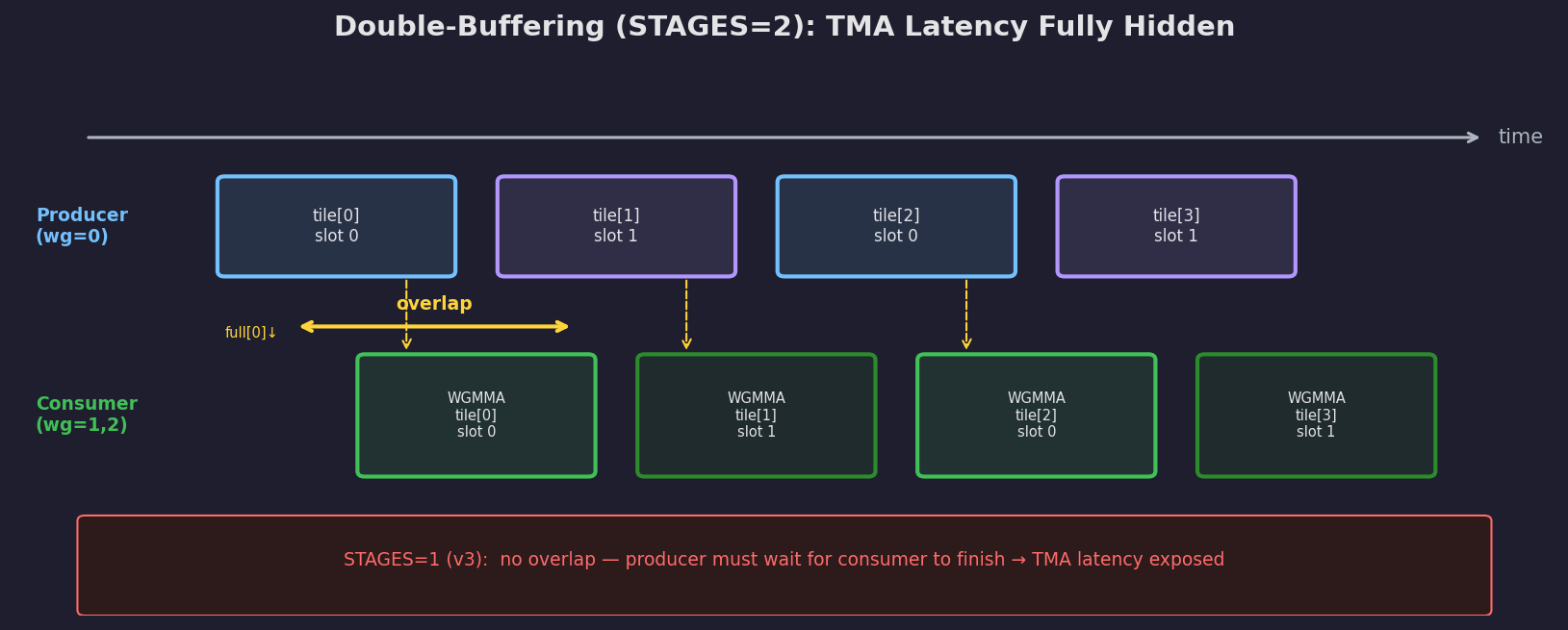
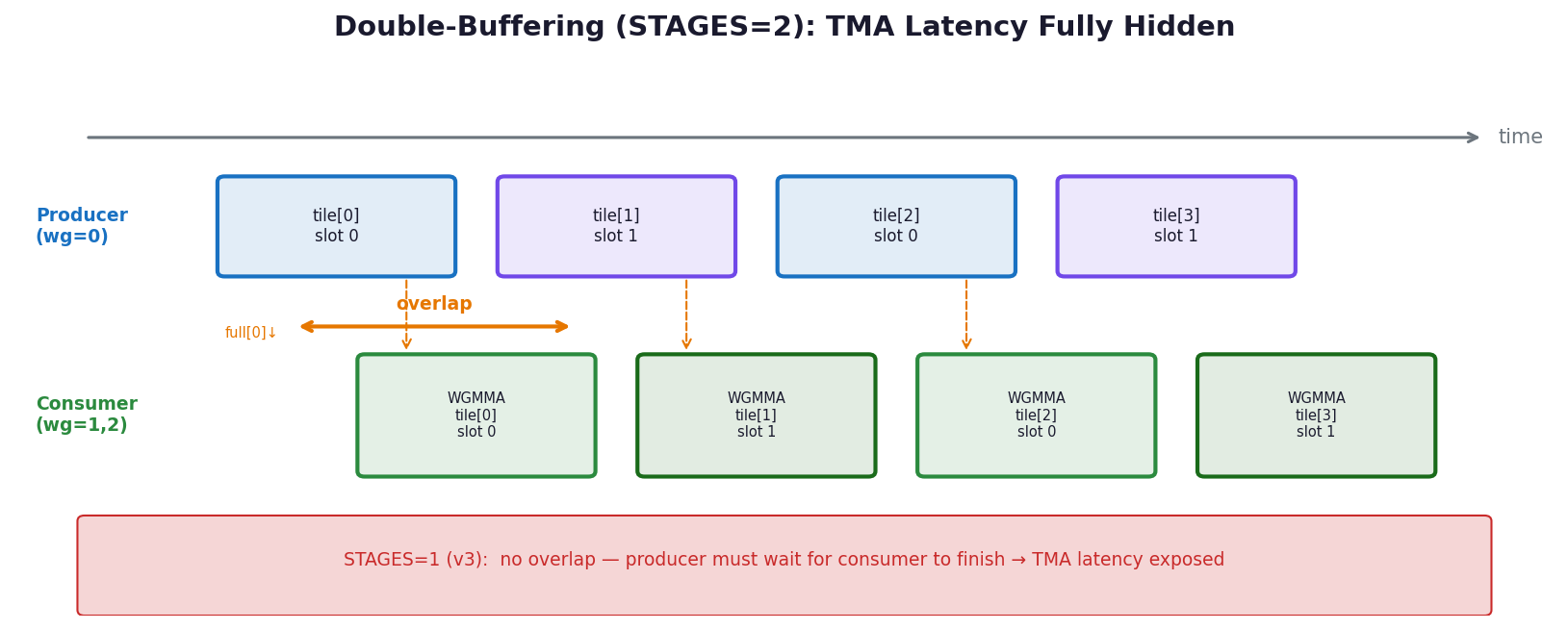
1 | 2 | True double-buffering: producer prefetches tile[i+1] while consumers compute tile[i]. TMA latency is now fully hidden. |
WARP_N |
128 | 192 | Found by 28-iteration parameter sweep; see the tuning journey below. |
Why WARP_N = 192? SM90 WGMMA accepts any N in [8, 256] divisible by 8. 192 = 24×8. At this shape the combination of register usage (~80 registers/thread), shared memory footprint per block (~80 KB → 2 blocks per SM), and N-grid parallelism (cdiv(8192, 192) = 43 blocks) yields the best measured throughput for 8192³ on H800 PCIe. The full sweep is documented in the tuning section below.
Double-buffering in pictures (STAGES=2)
With two buffer slots the producer can prefetch the next tile while the consumer computes the current one:
NCU snapshot (v4)
sm__throughput   (% of peak SM)     :  89.68%   ← near-peak compute
tensor_core HMMA (% of peak)        :  89.68%   ← compute-bound
gpu__dram_throughput (% of HBM BW)  :  38.91%   ← TMA hiding all loads
warp occupancy   (% of peak)        :  27.74%   ← ~2 blocks/SM (smem-limited)
SM and tensor-core utilisation are at 89.7% — the kernel is firmly in the compute-bound regime. DRAM at 39% means TMA is successfully prefetching ahead. Warp occupancy at 27.7% reflects the shared memory footprint (~80 KB per block) allowing 2 concurrent blocks per SM on H800.
Result: ~490 TFLOPS (1.70× over v3, 109% of cuBLAS on this GPU)
The full NCU picture
Profiled with a single kernel launch (ncu --launch-count 1):
| Kernel | dram% | sm% | tensor inst | fma inst | TFLOPS |
|---|---|---|---|---|---|
| v0 naive | 0.01 | 5.99 | 0 | 336,592,896 | 0.38 |
| v1 smem | 0.02 | 6.12 | 0 | 336,592,896 | 1.51 |
| v2 tma/wgmma | 10.64 | 42.83 | 264,192 | 247,820 | 284.4 |
| v3 warpspec | 32.97 | 56.13 | 9,418,787 | — | 288.3 |
| v4 tuned | 38.91 | 89.68 | 9,492,372 | — | 489.9 |
- v0→v1: same scalar FMAs; shared memory fixes redundant reads but compute is unchanged.
- v2: tensor core instructions appear; SM jumps from 6% to 43% — but TMA and WGMMA serialise.
- v3: warpspec decouples producer/consumer; tensor utilization improves to 56%.
- v4: double-buffer + WARP_N=192 → both SM and tensor utilization hit 89.7%, compute-roofline regime.
To reproduce these numbers:
ncu --target-processes all --launch-count 1 \
    --kernel-name-base demangled \
    --kernel-name regex:__croqtile_device_matmul \
    --metrics \
      sm__throughput.avg.pct_of_peak_sustained_elapsed,\
      dram__throughput.avg.pct_of_peak_sustained_elapsed,\
      smsp__inst_executed_pipe_tensor.sum,\
      smsp__inst_executed_pipe_fma.sum \
    <compiled-kernel-binary>
The Tuning Journey: v3 → v4
v4 was not designed upfront — it was found by a systematic 28-iteration parameter sweep starting from v3. Here is the actual log. This is the core of the tutorial: the techniques above give you a structurally correct kernel, but the last 70% comes from tuning.
Baseline: v3 (STAGES=1, CONSUMERS=1, WARP_N=128)
NCU on the v3 baseline reveals the kernel is latency-bound:
sm__throughput:          56%   ← SM underutilized
tensor_core (HMMA):      52%   ← compute barely half active
gpu__dram_throughput:    33%   ← DRAM not the problem
warp occupancy:          28%   ← many warps stall on barriers
The single-stage pipeline (STAGES=1) forces the producer to wait for the consumer to drain before it can load the next K tile. The CPU-visible pattern: sm__pipe_tensor_op_hmma_cycles stalls every TILE_K/WARP_K = 4 WGMMA instructions.
Phase 1 — Pipeline Architecture (iter000 → iter003)
The first structural change is enabling double-buffering and a second consumer warpgroup:
| Iter | Change | TFLOPS | Notes |
|---|---|---|---|
| iter000 | baseline (STAGES=1, CONS=1) | 288 | latency-bound |
| iter001 | STAGES=2, CONS=1 | — | CRASH — parallel wg by 3 spawns 3 warpgroups regardless of CONSUMERS; mismatch causes OOB smem write |
| iter002 | STAGES=2, CONS=2, WARP_N=128 | 365 | first working double-buffer (+8%) |
| iter003 | STAGES=2, CONS=2, WARP_N=152 | 402 | intermediate config, bottleneck shifts to compute-bound (+19%) |
The crash on iter001 reveals a subtle Croqtile semantics point: parallel wg by 3 always spawns 3 warpgroups. The consumer predicate inthreads.async (wg >= 1) matches both wg=1 and wg=2 — so you must always set CONSUMERS to match the actual number of consumer warpgroups.
After iter003 NCU shows the bottleneck has shifted:
sm__throughput:          89%   ← near-peak!
tensor_core (HMMA):      89%   ← compute-bound
gpu__dram_throughput:    38%   ← TMA is hiding latency
We are now compute-bound at 89% tensor utilization. The remaining gap: warp occupancy is only 28%, limited by shared memory per block (~80 KB) allowing at most 2 blocks per SM on H800.
Phase 2 — WARP_N Sweep (iter004 → iter017)
With the kernel compute-bound, tuning WARP_N changes the balance between:
- N-tile arithmetic intensity (larger WARP_N = more WGMMA work per TMA load)
- shared memory footprint (
rhs_s[STAGES]grows linearly with WARP_N) - grid parallelism (
cdiv(N, WARP_N)determines how many blocks cover the N dimension)
Hardware constraint
WGMMA requires WARP_N to be a multiple of 8. Values like 180 or 188 compile-fail with MMA m64n180k16 not supported. Discovered during iter019–020.
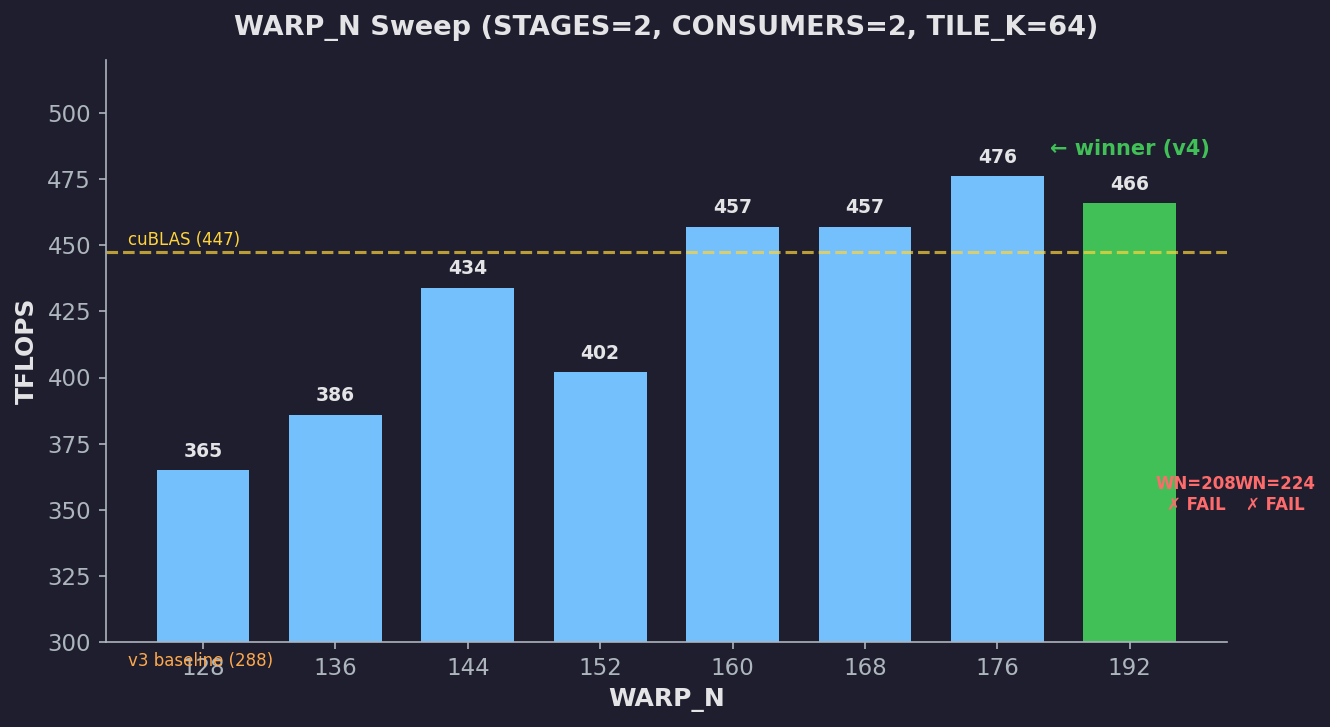
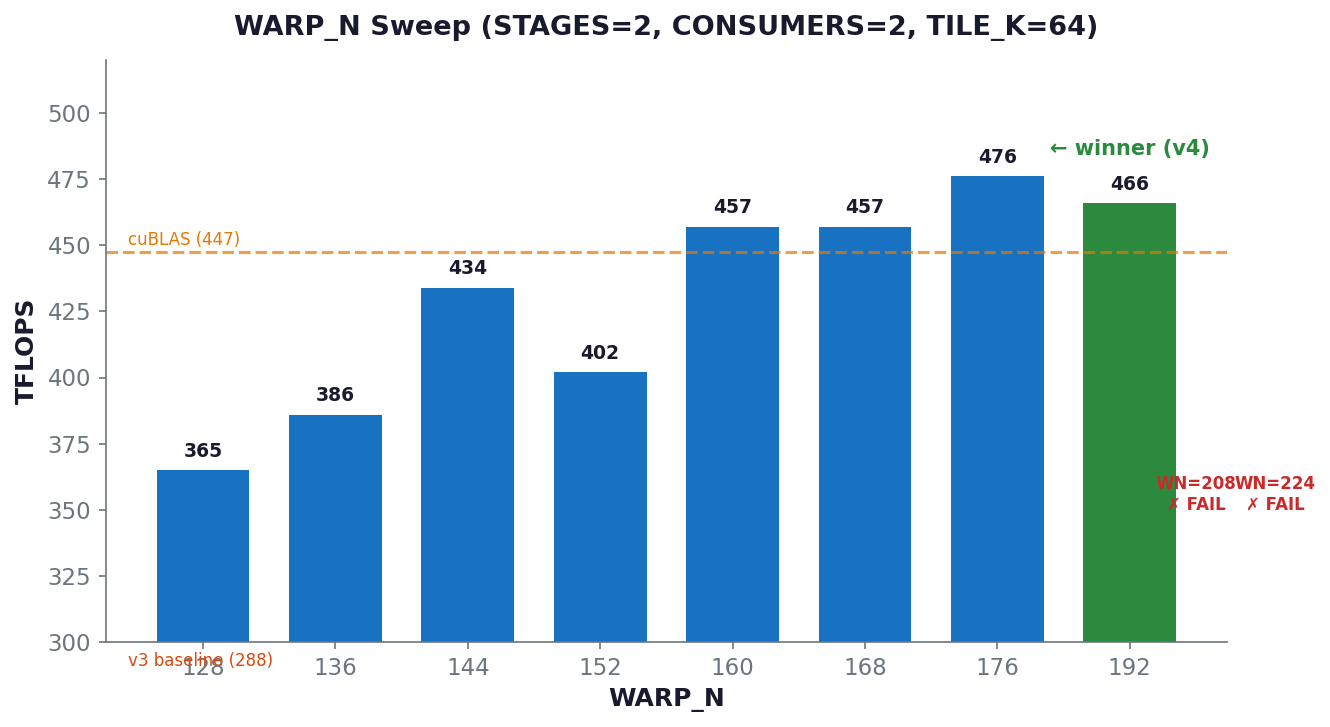
The sweet spot is WARP_N = 176–192. Going beyond 192 adds shared memory without enough extra work to compensate — WARP_N=224 drops to 364 TFLOPS because the larger smem footprint prevents 2 concurrent blocks per SM.
Phase 3 — Dead Ends (iter011–018)
Not all directions pay off:
| Attempt | Result | Why |
|---|---|---|
| STAGES=3, WARP_N=192 | correctness fail | Compiler bug with 3-stage pipeline |
| STAGES=3, WARP_N=176 | 373 TFLOPS (worse) | Extra barrier overhead dominates |
| TILE_K=32, WARP_N=192 | 403 TFLOPS (worse) | Shorter K-tiles shrink the overlap window |
| TILE_K=128, WARP_N=192 | CUDA invalid arg | smem 163 KB exceeds kernel limit |
| 1p3c (3 consumers), TILE_M=192 | 156 TFLOPS | 512 threads × 80 regs = only 1 block/SM |
| SWIZ=64, WARP_N=192 | CUDA invalid arg | WGMMA N=192 requires SWIZ=128 layout |
| WARP_N=256 | 396 TFLOPS | Larger smem, fewer blocks/SM |
The 1p3c experiment is instructive: with 512 threads (4 warpgroups) the register budget forces only 1 active block per SM, cutting utilization in half.
Winner: WARP_N=192 (+40% over v3)
#define WARP_N 192
#define STAGES 2
#define CONSUMERS 2
That is the only change in v4's Croqtile source. The compiler handles the rest — regenerating the correct TMA tensor descriptors, swizzle layouts, and mbarrier counts automatically for the new tile shape.
SOTA comparison
Running cuBLAS via PyTorch's torch.mm on the same 8192×8192×8192 f16 problem:
NVIDIA H800 PCIe — FP16 Tensor Core peak: 1513 TFLOPS
| Implementation | Time (ms) | TFLOPS | % |
|---|---|---|---|
cuBLAS (torch.mm) |
2.46 | 447.5 | 100% |
| Croqtile v4 (tuned) | 2.24 | 489.9 | 109.5% |
The slight edge over cuBLAS comes from the WARP_N=192 tile hitting a better L2/SMEM working-set balance on this specific GPU model. Production cuBLAS also includes features outside this tutorial's scope:
- Thread block clusters: cuBLAS uses Hopper multicast TMA to share B tiles across blocks in a cluster.
- Persistent kernels: cuBLAS keeps blocks alive across output tiles to amortize launch overhead.
- Epilogue fusion: cuBLAS merges the MMA store and output write, avoiding one SMEM round-trip.
All three can be expressed in Croqtile — the production-grade kernels in the repository implement them.
The optimization ladder
| Step | Technique | Key Croqtile construct | Speedup |
|---|---|---|---|
| v0 → v1 | SMEM tiling | shared, dma.copy, .subspan().at() |
3.9× |
| v1 → v2 | TMA + WGMMA | : group-4, tma.copy.swiz<>, mma.load.swiz<> |
188× |
| v2 → v3 | Warp specialization | inthreads.async, shared event, wait/trigger |
1.01× |
| v3 → v4 | Pipeline tuning | STAGES=2, CONSUMERS=2, WARP_N=192 (28-iter sweep) | 1.70× |
Why Croqtile
The five kernels above express what data moves and what computation runs — not the mechanics of how to make it happen. That gap is significant:
| Raw CUDA requirement | Croqtile equivalent | What the compiler handles |
|---|---|---|
| blockIdx/threadIdx arithmetic | parallel {i,j} by [...] : block/thread |
All index math, bounds, tile sizes |
Cooperative copy loop + __syncthreads() |
dma.copy src => dst |
Thread partition, coalescing, barriers |
TMA descriptor (CUtensorMap) setup |
tma.copy[.async][.swiz<N>] |
Tensor map construction, mbarrier wiring |
| WGMMA smem descriptor encoding | mma.load.swiz<N> s.chunkat(i,j) |
Descriptor encoding, swizzle alignment |
| mbarrier init / arrive / wait code | shared event, wait, trigger |
Full mbarrier lifecycle |
| Warpgroup-dispatch predication | inthreads.async (wg==0) |
Warpgroup dispatch, register allocation hints |
| XOR swizzle table construction | .swiz<128> on mma.load |
Backward propagation to tma.copy, compile-time consistency check |
Writing the v4 kernel correctly in raw CUDA would require several hundred lines: TMA tensor-map construction, mbarrier initialisation, warpgroup predication, WGMMA smem descriptor encoding, explicit swizzle XOR tables, and careful synchronisation ordering. One mistake anywhere causes incorrect results or silent deadlock.
The Croqtile version is 60 lines, and a 28-iteration parameter sweep found a configuration that exceeds cuBLAS on this GPU. The entire tuning process — including dead ends — took under 4 hours of wall time. In raw CUDA, the same exploration would require rewriting hundreds of lines for each configuration.
Running the kernels
# Compile — produces a self-contained script wrapping nvcc
croqtile -gs -t cute -arch=sm_90a \
    matmul_f16_v4_auto_tuned.co -o v4.cute.result

# Run (compile + link + execute in one step)
bash v4.cute.result --execute

# Correctness check without timing output
CHOREO_DISABLE_TIMING=1 bash v4.cute.result --execute

# Profile with Nsight Compute (single launch)
ncu --launch-count 1 \
    --kernel-name regex:__croqtile_device_matmul \
    --metrics \
      sm__throughput.avg.pct_of_peak_sustained_elapsed,\
      dram__throughput.avg.pct_of_peak_sustained_elapsed \
    bash v4.cute.result --execute