Advanced Data Movement: TMA, Swizzle, and Irregular Access
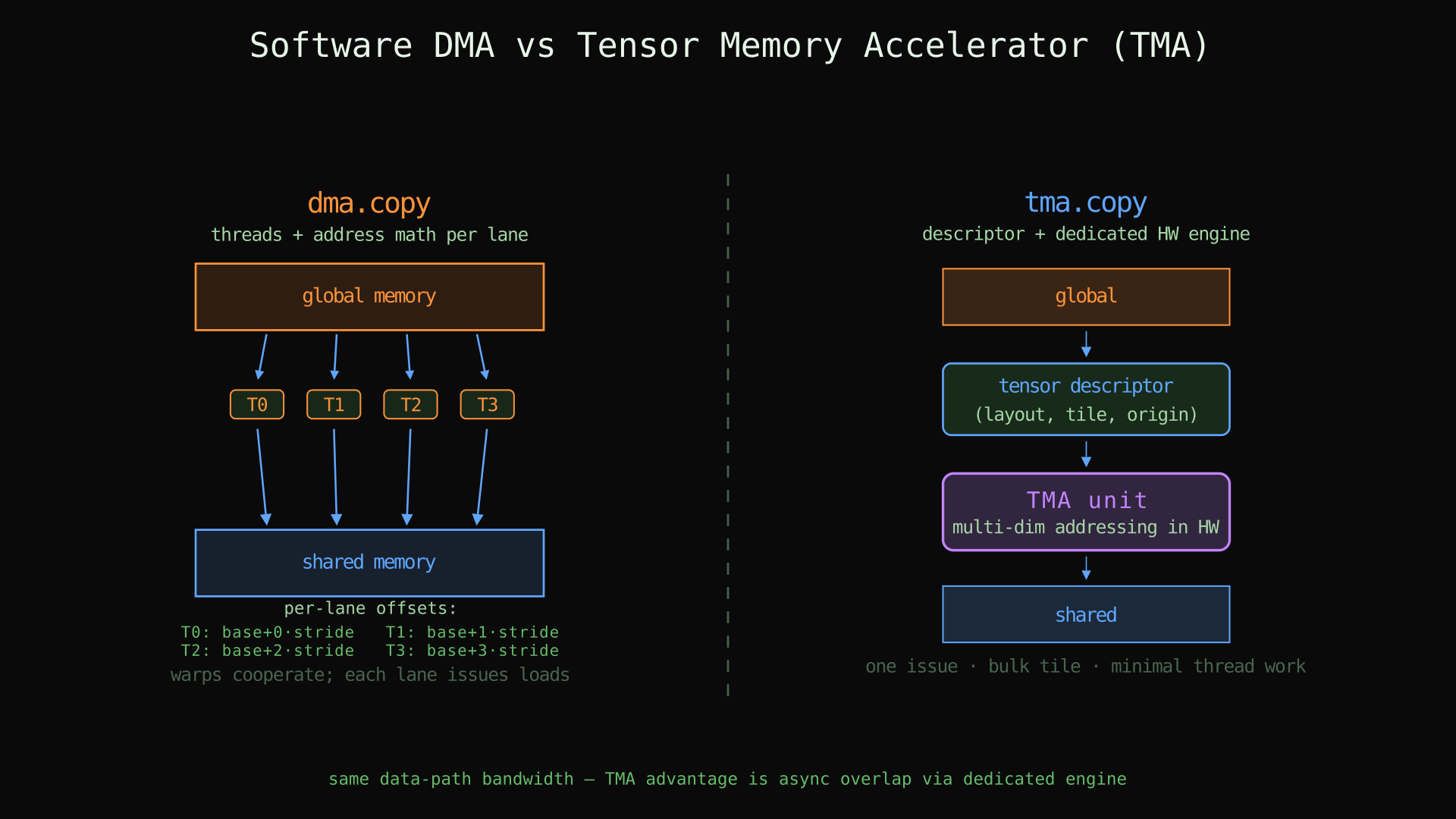
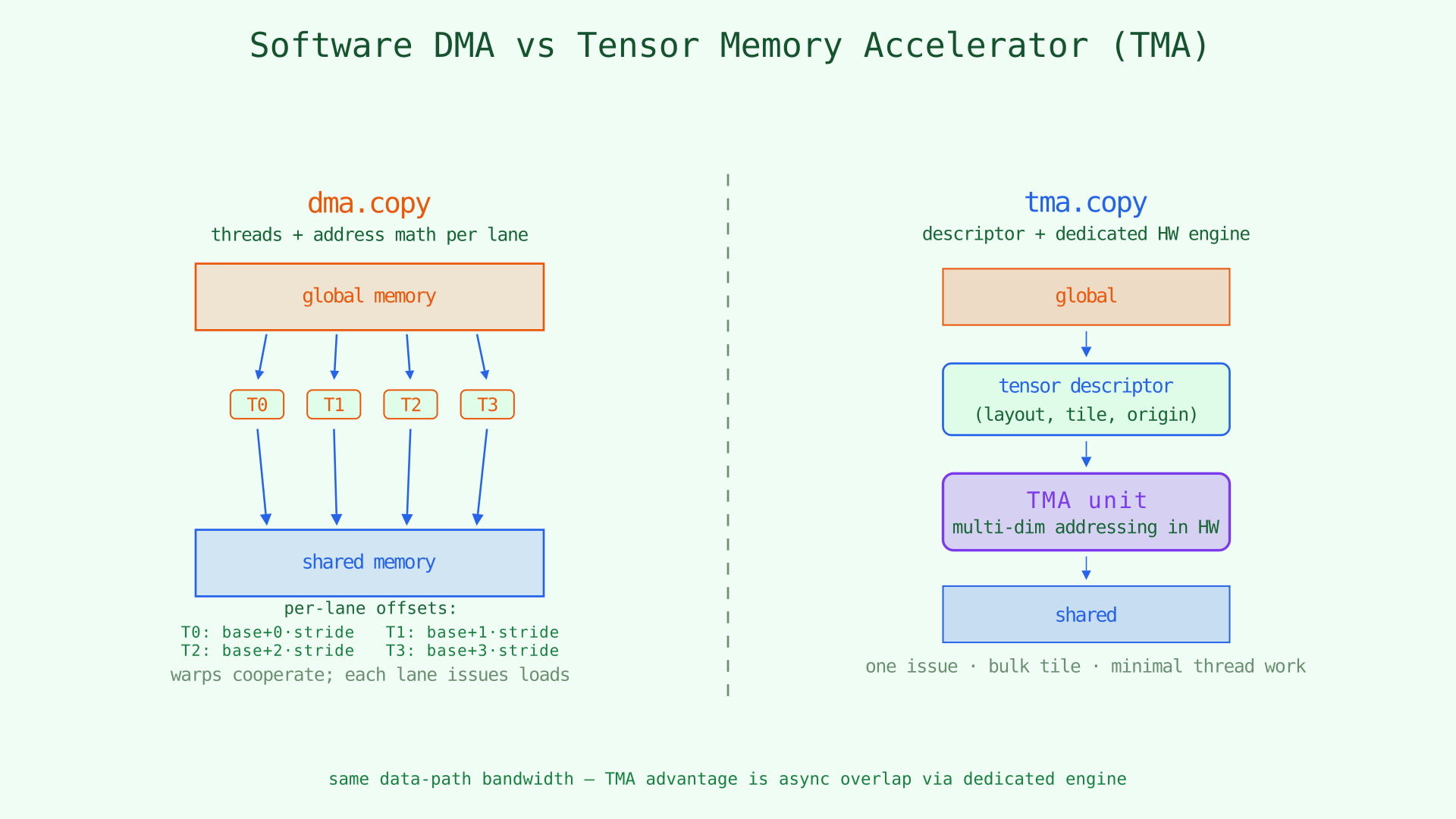
Chapter 2 introduced dma.copy as Croqtile's general data movement primitive — a way to move rectangular tiles between memory spaces using a simple src => dst arrow syntax. Under the hood, DMA copies are software-driven: every thread in the warpgroup participates in address computation and load issuance. The hardware sees dozens of individual load instructions, one per thread, that collectively assemble a tile in shared memory.
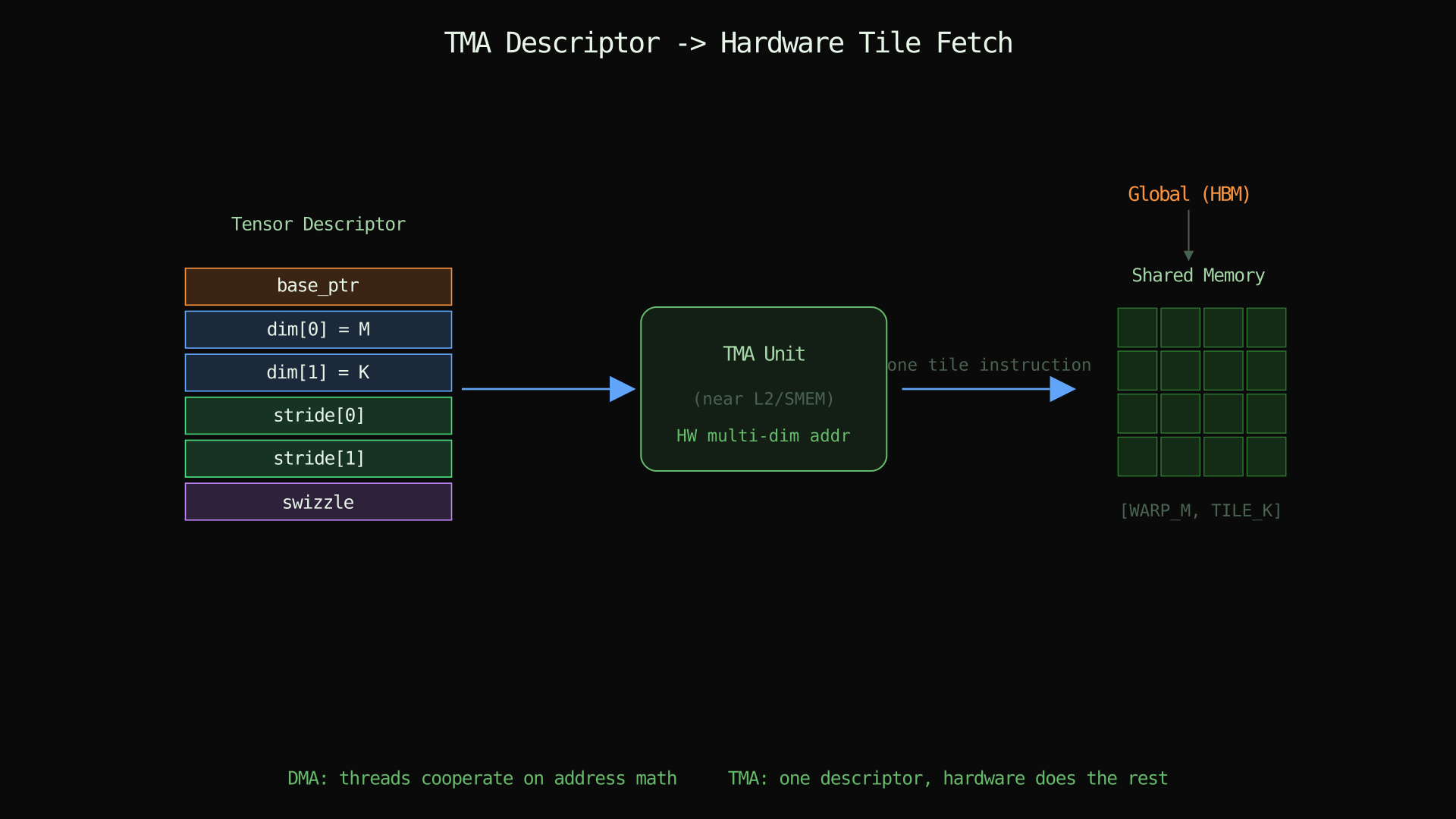
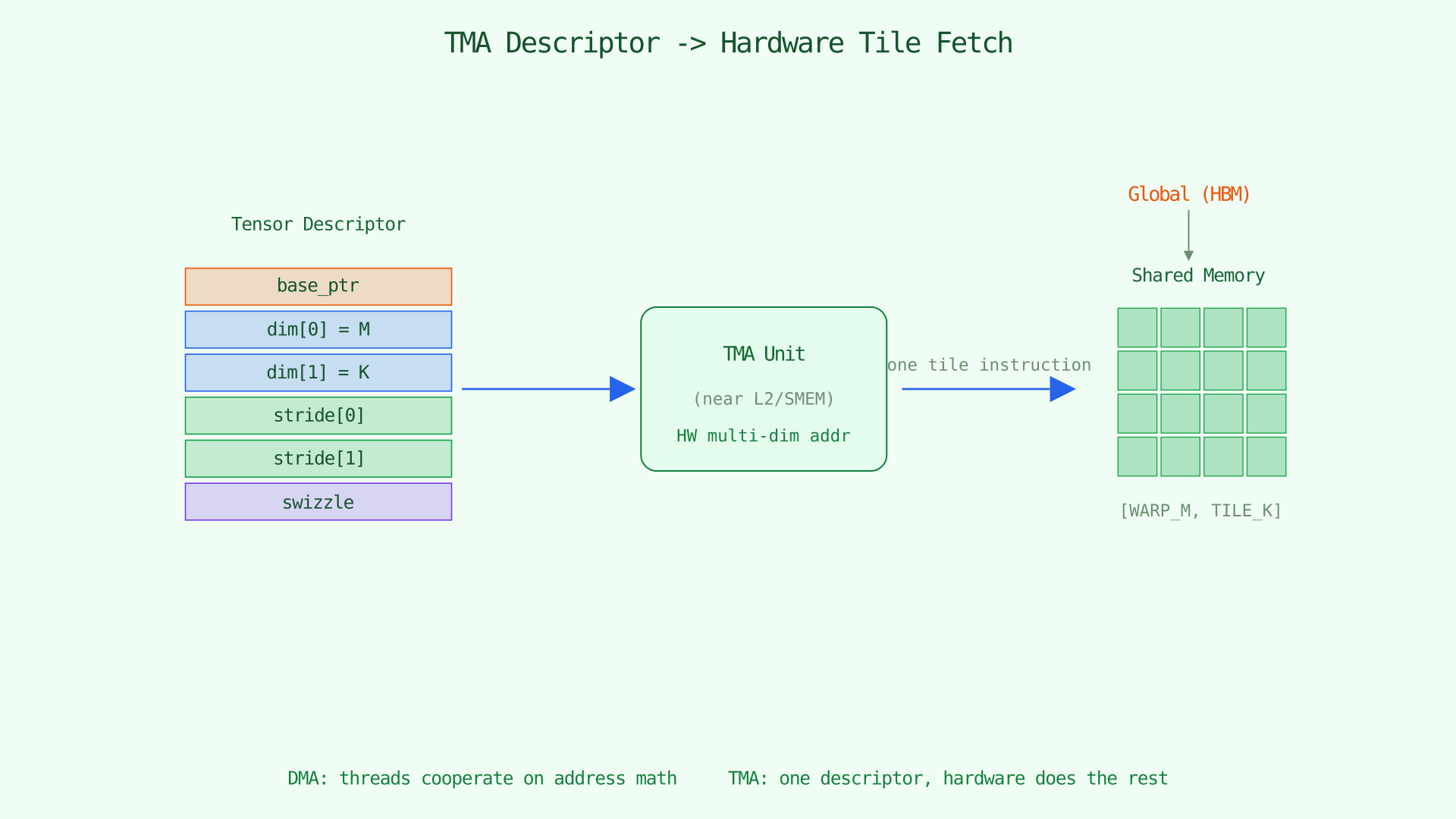
NVIDIA's Hopper GPUs (SM90+) add a second mechanism: the Tensor Memory Accelerator (TMA). TMA is a physical hardware unit sitting near the L2 cache / shared memory interface. Instead of threads cooperatively issuing loads, a single thread issues one descriptor-based instruction, and the TMA engine handles everything: multi-dimensional address computation, boundary clamping, and the actual data transfer.
A common misconception is that TMA moves data faster than DMA. It does not — both paths ultimately travel the same HBM → L2 → shared-memory data highway at the same bandwidth. The advantage is elsewhere: TMA has its own dedicated engine that runs independently of the SM's instruction pipeline. Once the descriptor-based instruction is issued, the TMA hardware performs the transfer in the background while the issuing thread (and all other threads in the warpgroup) are free to execute compute instructions. With dma.copy, the threads that participate in address math and load issuance are occupied for the duration of the transfer; with tma.copy, they can overlap the transfer with MMA or other work. In a warp-specialized pipeline (Chapter 5–6), this is the difference between a producer that blocks on loads and a producer that fires-and-forgets.
The two paths differ in interface, not in throughput:
dma.copy— Threads cooperatively issue loads. The programmer controls nothing about address patterns — Croqtile handles coalescing automatically. Flexible: works on any CUDA GPU since it compiles to standard load instructions.tma.copy— One descriptor-based instruction. The TMA hardware expands it into multi-dimensional addressing, applies swizzle, and handles boundary clamping. Hopper (SM90+) only. The descriptor is built by the compiler from your__co__signature and global layout.
Croqtile exposes TMA through the same arrow syntax as DMA — tma.copy instead of dma.copy. The rest of this chapter covers TMA, swizzle, the irregular-access utilities for real-world edge cases, and how Croqtile's design philosophy trades generality for guaranteed performance.
tma.copy: hardware tensor movement
The surface syntax mirrors dma.copy:
tma.copy lhs.subspan(WARP_M, TILE_K).at(block_m, iv_k) => lhs_load_s;Same source expression, same => destination form. The difference is who does the work:
- DMA path. Threads cooperate to cover the tile; each lane participates in address math and load issue. Throughput scales with how well you keep those loads bank-friendly.
- TMA path. One descriptor-based operation describes the tensor slice; the TMA hardware expands it into multi-dimensional addressing and moves the whole tile as a unit. Producer threads can overlap other work because the hardware, not a warp's worth of threads, owns the transfer.
What this buys you. You still synchronize on the whole tile (with events or the pipeline discipline from Chapter 6), but you drop the per-thread load choreography. The compiler builds the tensor descriptor from your __co__ signature and global layouts.
Swizzle and bank conflicts
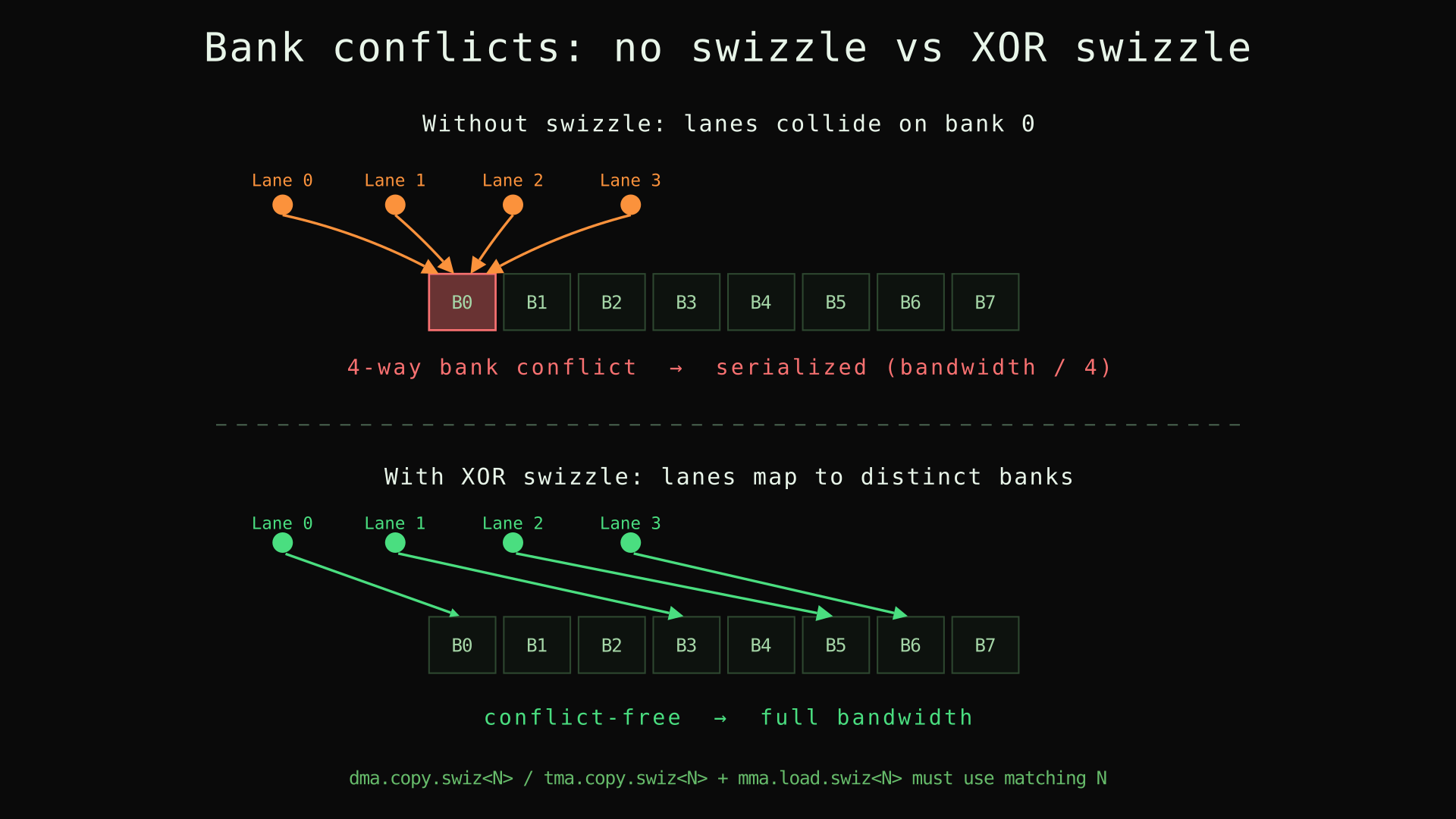
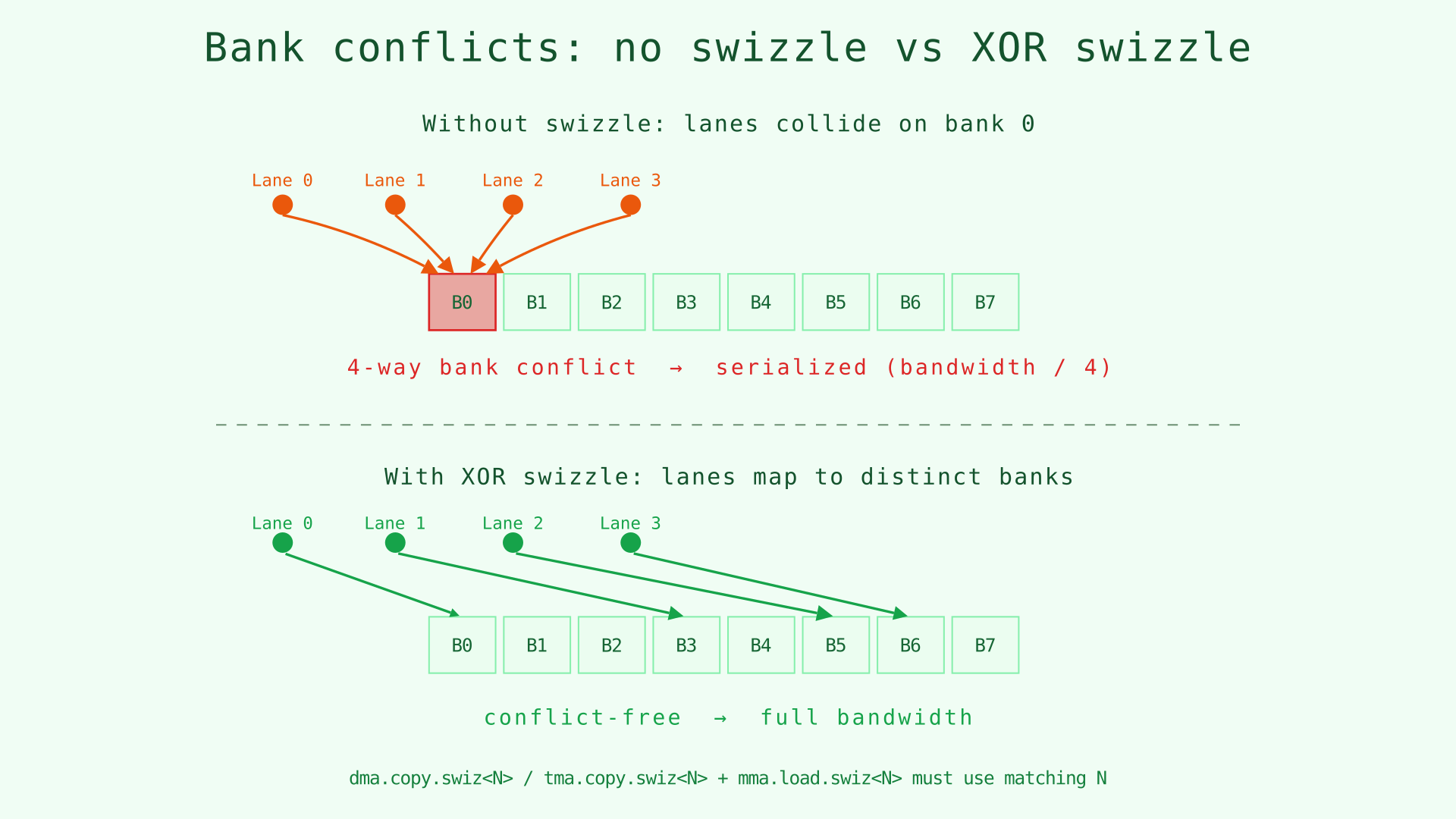
Shared memory is striped into 32 banks (4 bytes per bank). When multiple lanes in a warp touch different addresses that map to the same bank in the same cycle, the hardware serializes those accesses — a bank conflict. Dense row-major tiles often create 2-way, 4-way, or worse conflicts that cut effective bandwidth.
Swizzle applies a fixed XOR-style remapping to column indices within each row, spreading accesses across banks. Croqtile exposes it on both DMA and TMA, with the same syntax and the same effect:
dma.copy.swiz<3> src => dst;       // software DMA with swizzle
tma.copy.swiz<3> src => dst;       // hardware TMA with swizzle
The copy lands bytes in shared memory using swizzle pattern N. The MMA read path must use the same swiz<N> so addresses match the staged layout:
ma = mma.load.swiz<3> lhs_load_s.chunkat(_, iv_warp);Swizzle is not a TMA-specific feature. In Croqtile, dma.copy.swiz<N> and tma.copy.swiz<N> produce identical shared-memory layouts. The difference is only in how the data gets there (thread-cooperative loads vs. descriptor-based hardware transfer), not in how the data is arranged once it arrives.
Swizzle levels. The template argument sets the granularity: swiz<0> is identity, then 64B, 128B, and 256B XOR patterns for <1>, <2>, and <3>. Larger granularities defeat wider conflict patterns but require tile extents that line up with that granularity.
Matching rule. The <N> on the copy must match mma.load.swiz<N>. If you load with plain mma.load from swiz<3> data, addresses disagree and you read garbage. The compiler does not enforce the pairing — it is a correctness invariant you maintain. (As introduced in Chapter 4, mma.load.swiz<N> is part of the MMA load family.)
Why the restricted interface works: expressiveness vs performance
In raw CUDA, a programmer implementing data movement has enormous freedom: arbitrary pointer arithmetic, variable-stride access, hand-computed bank-conflict avoidance, custom swizzle formulas. This flexibility is a double-edged sword. The space of possible data movement patterns is vast, but the subset that actually performs well on GPU hardware is narrow — it requires coalesced global loads, conflict-free shared-memory access, and correct swizzle alignment. Getting any of these wrong silently degrades throughput by 2~32×.
Croqtile takes the opposite approach: it restricts the expressible patterns to those that are guaranteed to be in the performance sweet spot. When you write dma.copy or tma.copy, the compiler automatically handles coalesced access, bank-conflict-free layout, and swizzle alignment. There is no way to accidentally write a strided, uncoalesced global load or a bank-conflicted shared-memory layout — the syntax simply does not allow it.
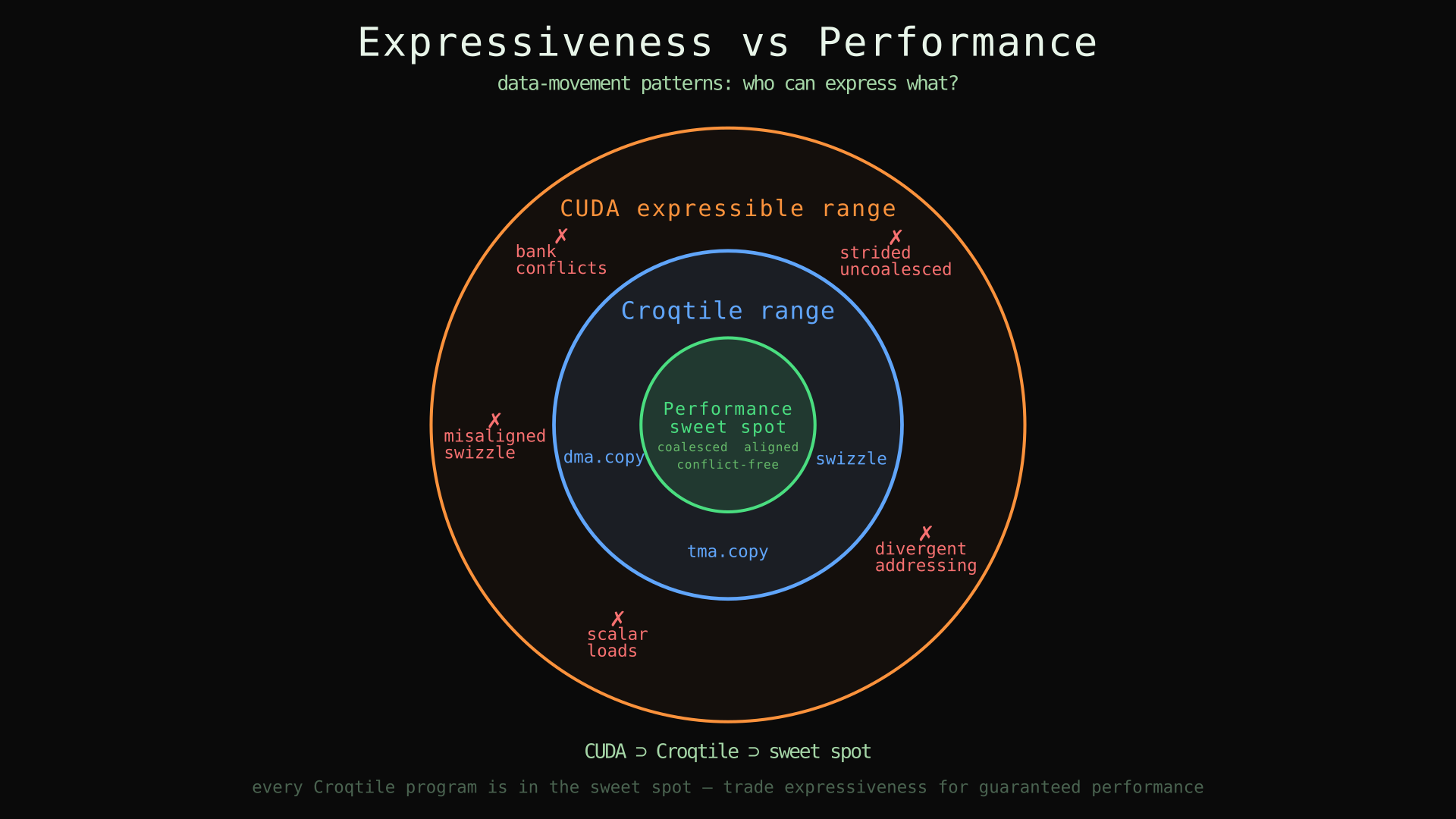
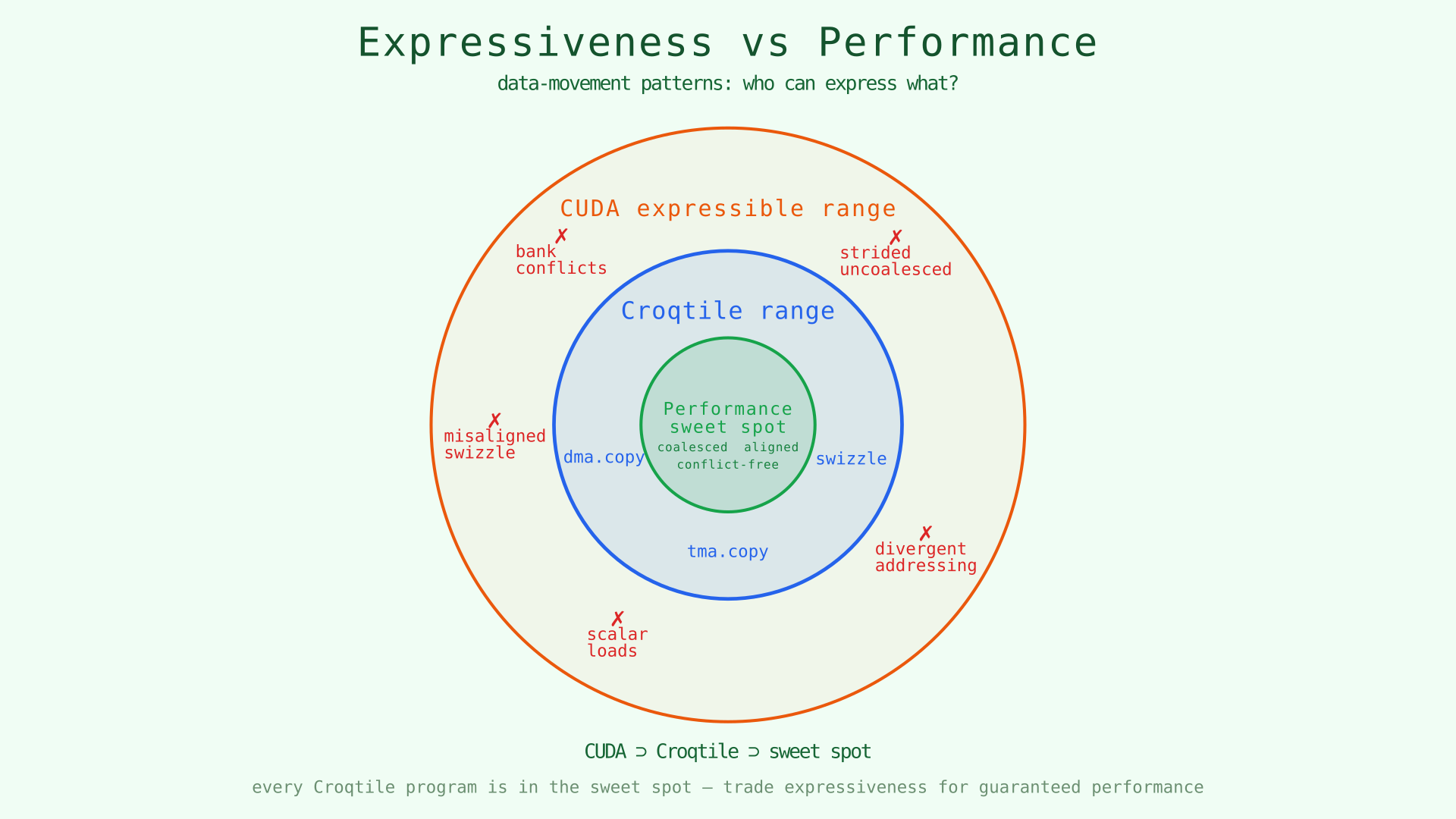
TMA's descriptor-based interface is an extreme instance of this philosophy: it supports only a few tile-aligned transfer patterns, but those patterns are exactly the ones the hardware is optimized for. Croqtile's dma.copy follows the same principle — it generates only patterns that are coalesced and conflict-free, even though the underlying LDG/STS instructions can express far more (including many slow patterns). The trade is explicit: you give up the ability to write arbitrary data movement, and in return, every data movement you write is fast.
Example: TMA in a pipelined matmul
The pipeline skeleton from Chapter 6 is unchanged: ring of stages, wait / trigger on events, MMA commit, consumer drains tiles while producer fills the next slot. Here the producer swaps dma.copy for tma.copy.swiz<3> and the consumer swaps mma.load for mma.load.swiz<3>:
__co__ void matmul(global f16 [M, K] lhs, global f16 [N, K] rhs, global f16 [M, N] output) {
  parallel {block_m, block_n} by [cdiv(M, WARP_M), cdiv(N, WARP_N)] : block {
    shared event full[STAGES], empty[STAGES];
    shared f16 [WARP_M, TILE_K] lhs_load_s[STAGES];
    shared f16 [WARP_N, TILE_K] rhs_load_s[STAGES];
    shared f16 [WARP_M, WARP_N] output_s;

    parallel p1 by 2 : group-4 {
      inthreads.async (p1 == 0) {
        foreach {iv_k} in [cdiv(K, TILE_K)] {
          stage = iv_k % STAGES;
          wait empty[stage];
          tma.copy.swiz<3> lhs.subspan(WARP_M, TILE_K).at(block_m, iv_k)
            => lhs_load_s[stage];
          tma.copy.swiz<3> rhs.subspan(WARP_N, TILE_K).at(block_n, iv_k)
            => rhs_load_s[stage];
          trigger full[stage];
        }
      }

      inthreads.async (p1 == 1) {
        mc = mma.fill.f16 0.0f;
        foreach {s} in [STAGES] { trigger empty[s]; }
        foreach {iv_k} in [cdiv(K, TILE_K)] {
          stage = iv_k % STAGES;
          wait full[stage];
          foreach {iv_warp} in [cdiv(TILE_K, WARP_K)] {
            ma = mma.load.swiz<3> lhs_load_s[stage].chunkat(_, iv_warp);
            mb = mma.load.swiz<3> rhs_load_s[stage].chunkat(_, iv_warp);
            mma.row.row mc, ma, mb;
          }
          mma.commit;
          trigger empty[stage];
        }
        mma.store mc, output_s;
        dma.copy output_s => output.subspan(WARP_M, WARP_N).at(block_m, block_n);
      }
    }
  }
}
Compared to the Chapter 6 dma.copy version, only the ingress and operand load lines change; events, staging indices, and commit stay the same. The writeback to global memory still uses dma.copy — choose TMA or DMA for stores according to your target.
Handling irregular access
The tiling primitives introduced so far — chunkat, subspan(...).at(...) — assume tensors that divide evenly into tiles. This works for textbook GEMM where M, N, K are multiples of the tile dimensions. Production kernels are rarely so tidy. Expert batches start at dynamic offsets. Convolution windows overlap. The last K-tile is almost never an exact multiple of TILE_K. Some inputs arrive as flat buffers that need reshaping before MMA can consume them.
Croqtile provides four tools for these cases. Each one modifies how the compiler interprets a tensor's addressing without touching the pipeline structure — DMA, TMA, MMA, events, swizzle all continue to work unchanged.
Arbitrary-offset windows: view and from
chunkat divides a tensor into a regular grid of equal-sized tiles. But what if the slice you need does not start on a tile boundary? Consider a mixture-of-experts (MoE) kernel: each expert processes a different number of tokens, so the starting row for each expert's operand is determined at runtime. You cannot precompute a fixed tile grid.
view(M, N).from(row, col) defines an M x N rectangle starting at any (row, col) — no alignment requirement:
patch = matrix.view(16, 16).from(37, 50);This is a [16, 16] slice starting at row 37, column 50. The origin can be any runtime value.
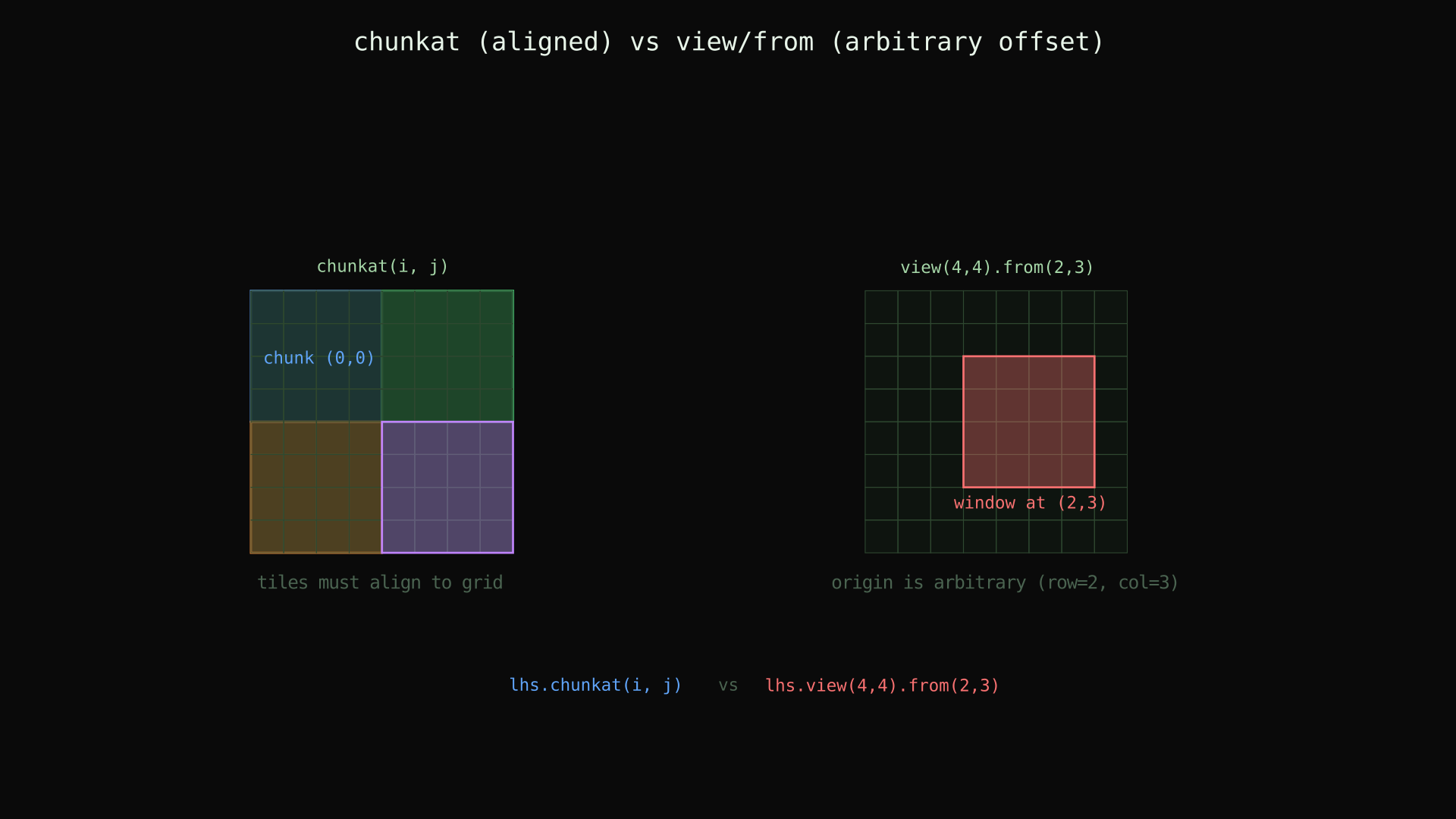
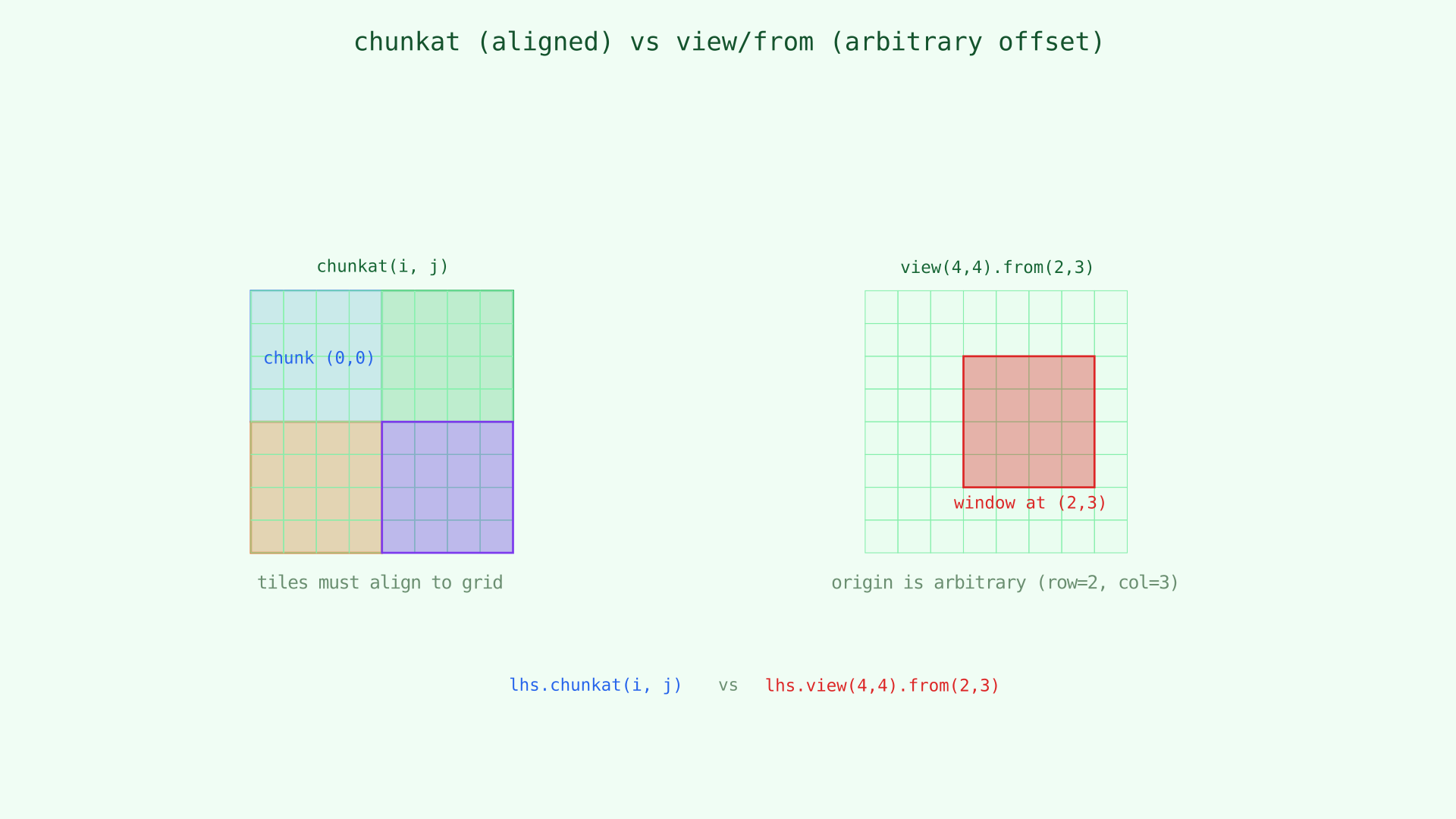
The power of view / from is composability: once you carve out a window, all downstream operations — subspan, chunkat, dma.copy, tma.copy — apply to the window as if it were a standalone tensor. The pipeline stays unchanged; only the origin shifts:
expert_lhs = lhs.view(expert_M, K).from(expert_offset, 0);
dma.copy expert_lhs.subspan(WARP_M, TILE_K).at(block_m, iv_k) => shared;
In an MoE stack, each expert's token batch starts at a dynamic row expert_offset. The view / from call rewires the operand at the top of the pipeline; everything below — DMA, staging, MMA loop — runs the same code for every expert.
When to use it. Prefer chunkat when the tensor divides evenly into tiles at compile time. Use view / from when the window's origin or extent is determined at runtime, or when the geometry does not align to the tile grid.
Strided tiles: .subspan, .step, and .at
subspan(M, K).at(i, j) selects the tile at logical tile indices (i, j) with extent [M, K]. By default, tiles are packed contiguously: tile (1, 0) starts immediately after tile (0, 0). But some layouts space tiles apart — either because there is padding between rows, or because a stencil kernel needs overlapping windows.
Adding .step(sM, sK) overrides the stride: tiles are spaced sM rows and sK columns apart instead of being packed:
matrix.subspan(16, 16).step(32, 32).at(i, j);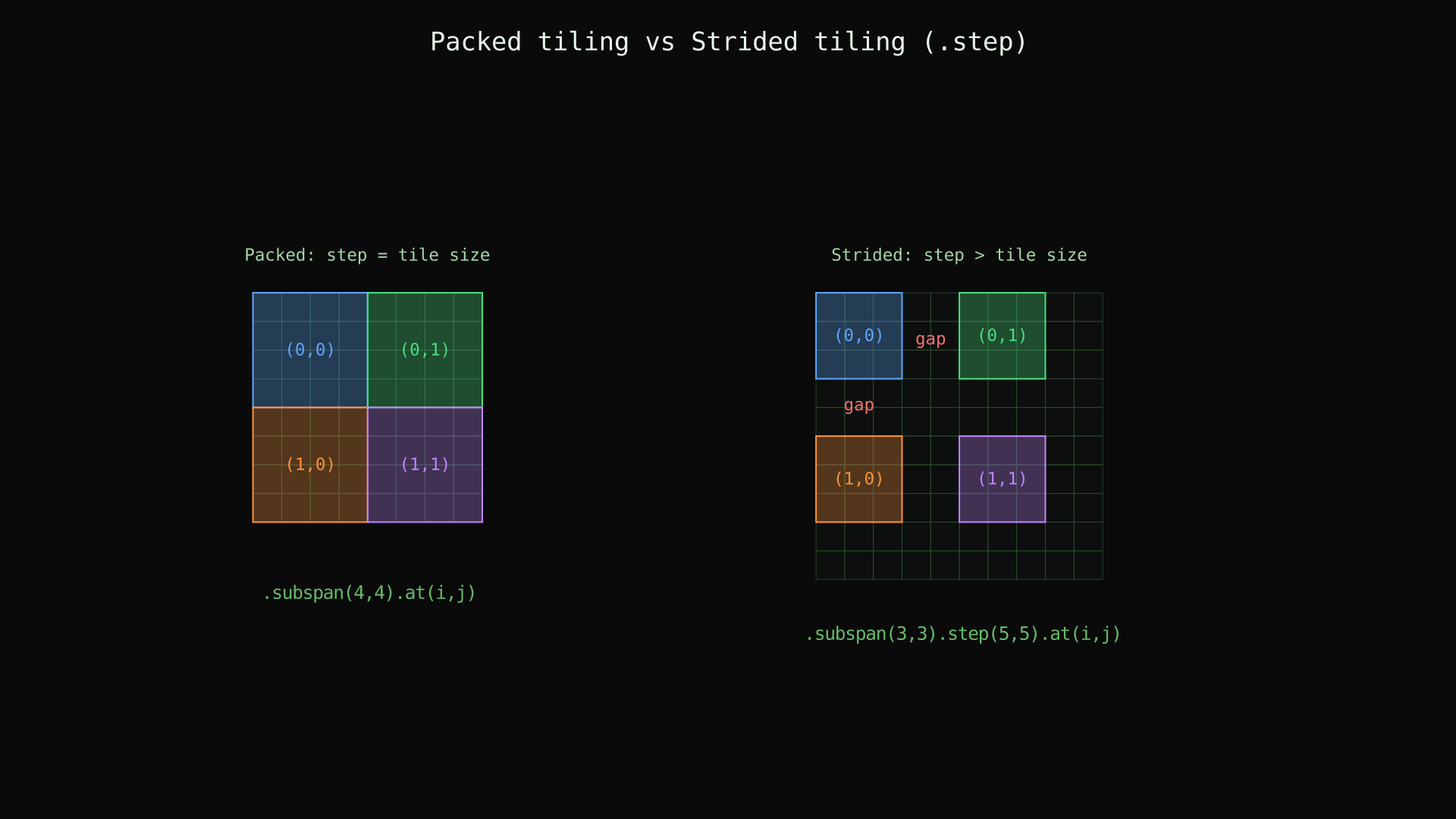
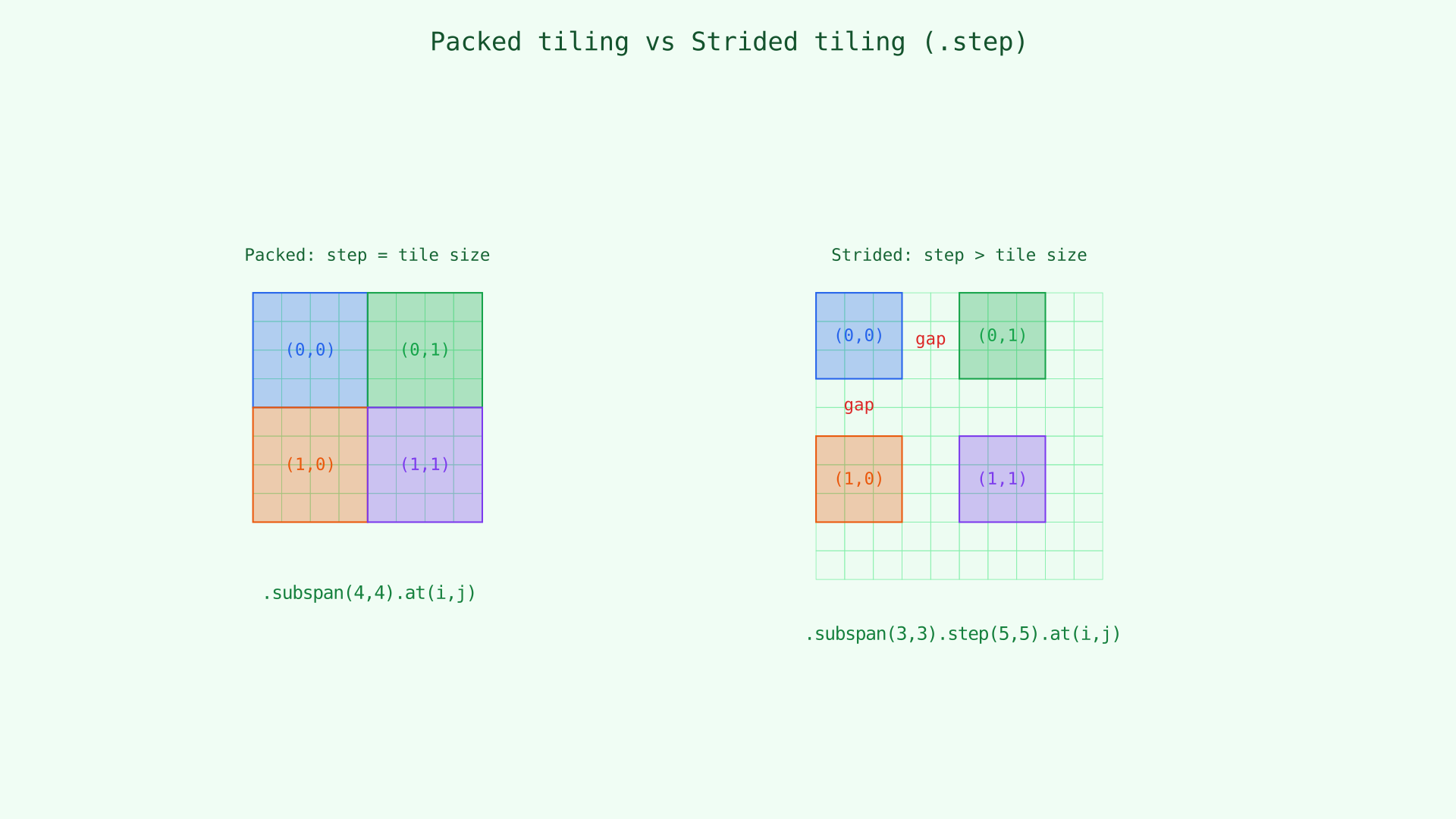
Tile (0,0) starts at (0,0), but tile (1,0) starts at row 32 (not row 16), leaving a 16-row gap. Omitting .step uses a step equal to the tile size — the packed case.
When you need this. Skipping padding or guard bands between rows. Overlapping stencil windows where the step is smaller than the tile extent (e.g., a 16 x 16 tile sliding by 8 rows). Matching an outer memory layout that is not dense tile-major — for instance, when tiles are interleaved with metadata.
Zero-padding: .zfill
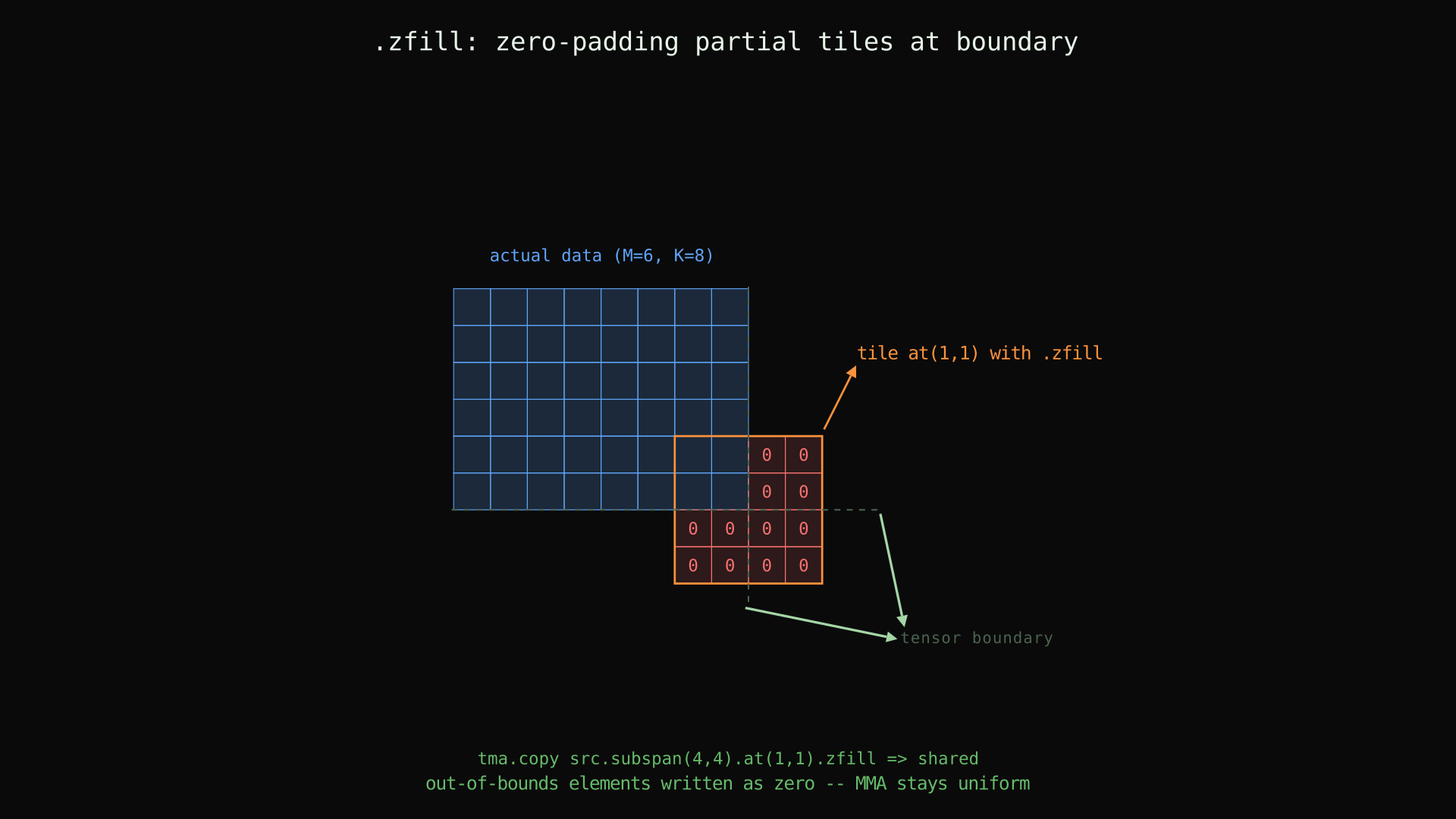
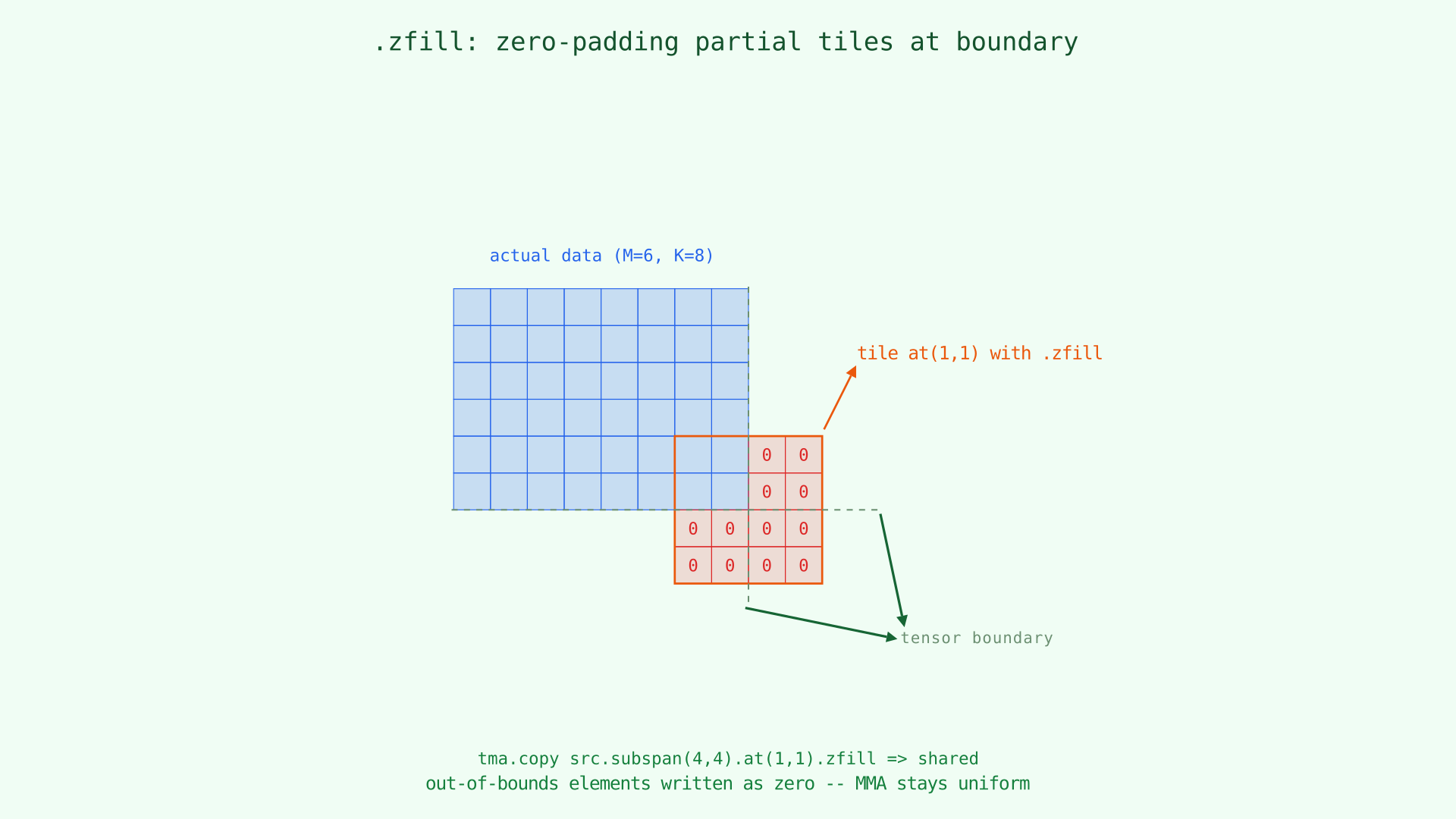
Every tiled kernel faces the same edge case: what happens when M or K is not a multiple of the tile size? The last tile along that axis is partial — some of its elements lie beyond the tensor boundary. Reading those addresses is undefined behavior on the GPU.
The brute-force fix is to add a special code path for the boundary tile. But this breaks the uniformity of the MMA loop and adds branches that the compiler cannot optimize away. .zfill solves this elegantly:
tma.copy.swiz<3> lhs.subspan(WARP_M, TILE_K).at(block_m, iv_k).zfill
  => lhs_load_s;
.zfill applies to the source side of a copy: out-of-range elements are written as zero in the destination tile. For a GEMM, zeros contribute nothing to the accumulation (0 × anything = 0), so the MMA loop stays completely uniform — same code for interior tiles and boundary tiles — while remaining mathematically correct. No branches, no special cases, no performance penalty.
Layout reinterpretation: span_as
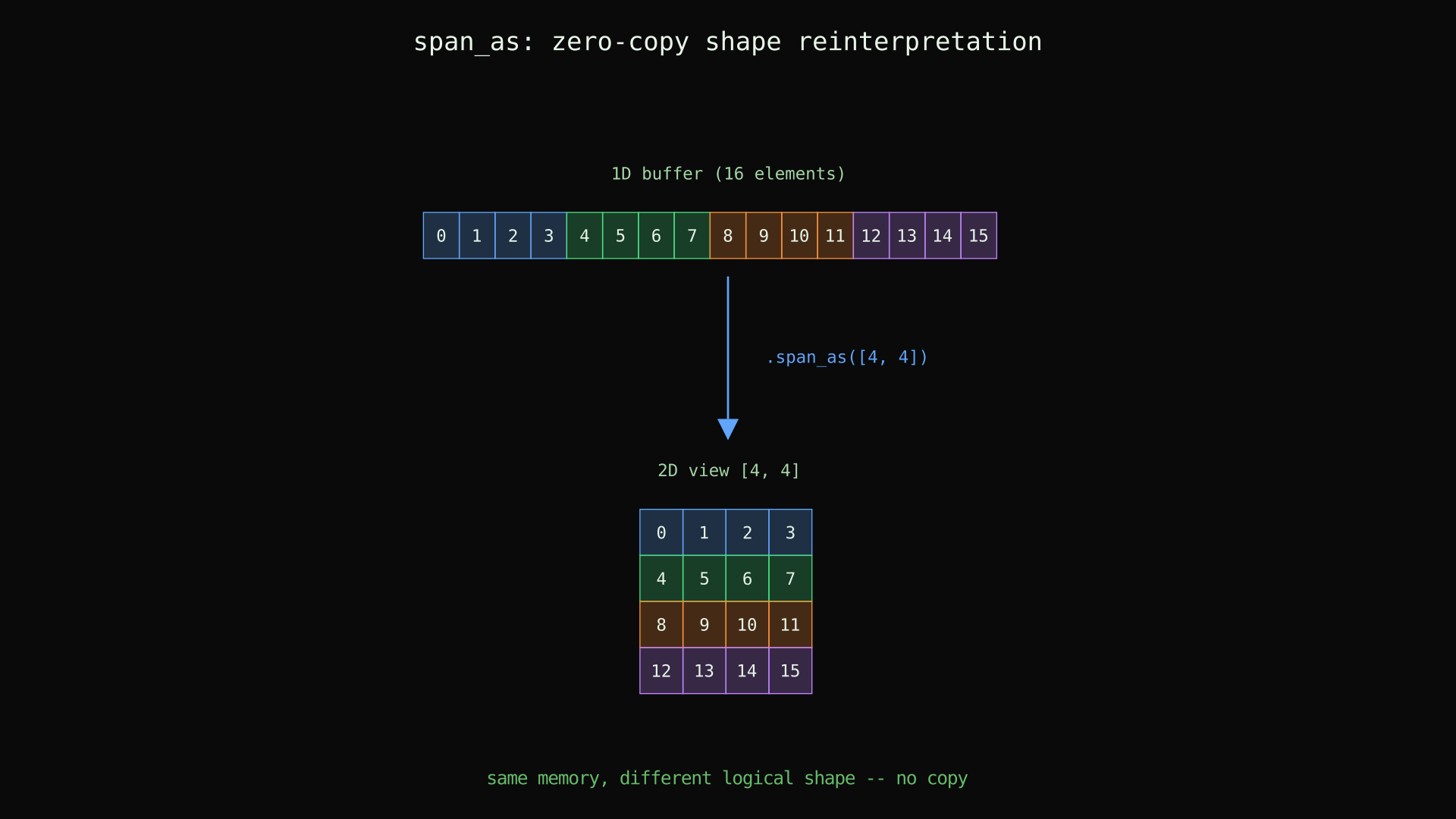
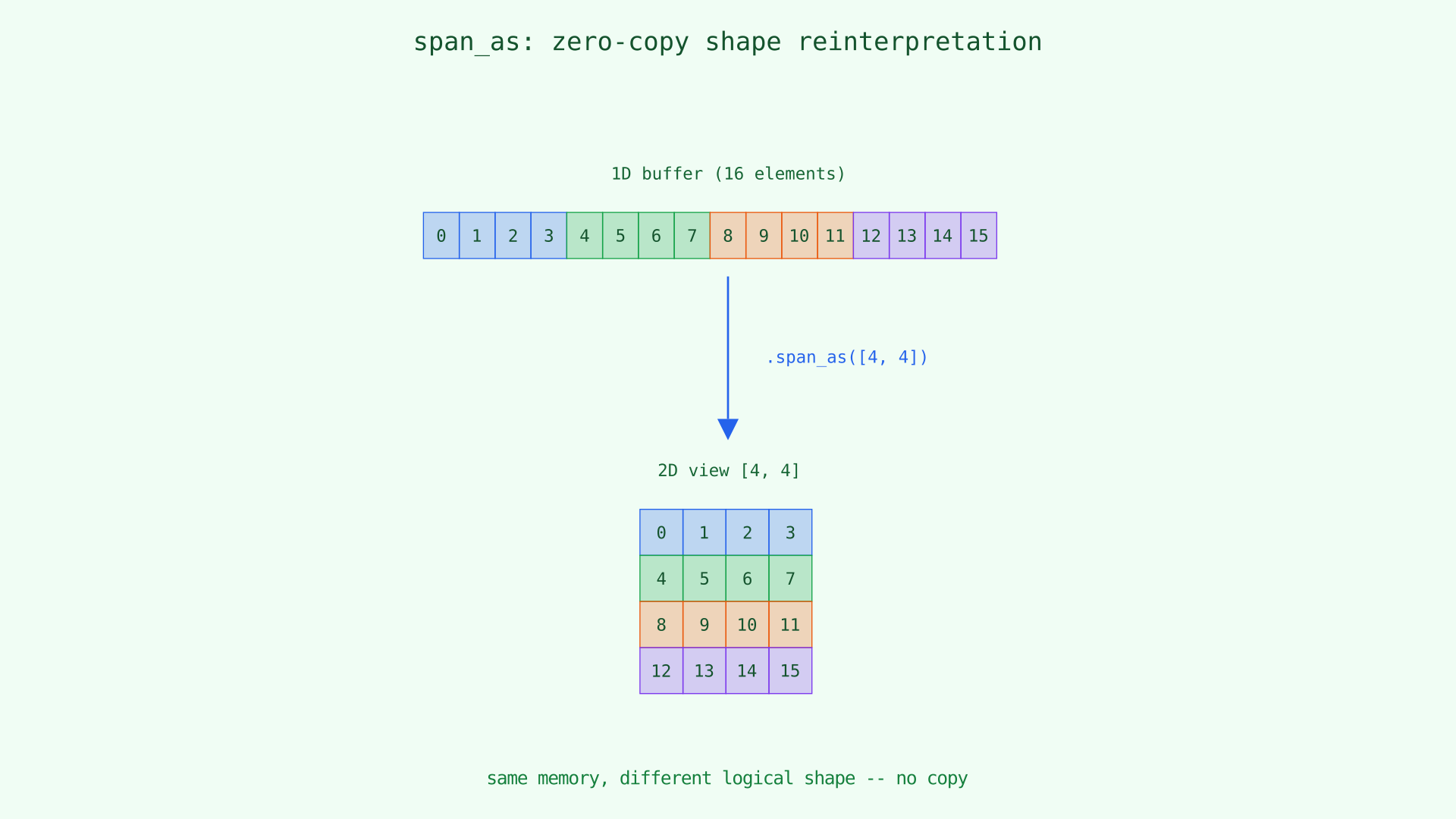
Some kernels load data as a flat 1D strip but need to feed it to MMA as a 2D matrix. A naive approach would copy the data into a reshaped buffer — wasting shared memory and bandwidth. span_as avoids this by reinterpreting the existing buffer's shape in place:
flat_buffer.span_as([rows, cols])Element count is preserved; only the logical rank changes. No data is moved.
strip_load = dma.copy data.chunkat(tile) => shared;
tile_2d = strip_load.data.span_as([tile_m, tile_k]);
ma = mma.load tile_2d.chunkat(_, iv_warp);
The loaded 1D strip is exposed as a 2D matrix for chunkat and MMA operand loading, without an extra copy or additional shared memory. rows * cols must equal the span length of the underlying storage, or the compiler rejects the program — this invariant is checked at compile time, not at runtime.
Chapter summary
| Concept | Syntax | Role |
|---|---|---|
| Software DMA (Ch. 2, 6) | dma.copy / dma.copy.swiz<N> |
Thread-cooperative tile transfer; works on all CUDA GPUs |
| Hardware TMA | tma.copy / tma.copy.swiz<N> |
Descriptor-driven Hopper ingress; dedicated engine enables async overlap |
| Swizzle | .swiz<N> on copy + mma.load.swiz<N> |
Bank-conflict-free SMEM layout; same effect for DMA and TMA |
| Expressiveness trade | — | Croqtile restricts patterns to guarantee coalesced, conflict-free transfers |
| Arbitrary windows | view(M,N).from(r,c) |
Ragged or runtime-positioned slices |
| Strided tiling | .subspan().step().at() |
Non-packed layouts, overlapping stencils |
| Partial tiles | .zfill |
Zero-fill out-of-bounds elements |
| Shape reinterpretation | span_as([dims]) |
Zero-copy reshape for staging buffers |
New syntax
| Syntax | Meaning |
|---|---|
tma.copy src => dst |
TMA hardware tensor copy (Hopper SM90+) |
tma.copy.swiz<N> src => dst |
TMA copy with swizzle mode N (0–3) |
dma.copy.swiz<N> src => dst |
DMA copy with swizzle mode N (0–3); same layout as TMA |
mma.load.swiz<N> src |
MMA operand load consistent with swizzle N |
.view(M, N).from(r, c) |
Arbitrary-offset M x N window |
.subspan(M, K).step(sM, sK).at(i, j) |
Strided tile selection |
.zfill |
Zero-fill out-of-bounds elements on copy source |
span_as(dims) |
Reinterpret linear storage as shaped tensor |
The next chapter steps past pure Croqtile into C++ interop: __device__ functions, register hints, preprocessor guards, and inline PTX when you need to drop down to the metal.