Synchronization in Practice: Pipelines, Buffers, and Events
Chapter 5 introduced three control-flow primitives: if for predicated execution, inthreads.async for structured concurrent regions, and events (shared event / wait / trigger) for inter-region signaling. This chapter puts them to work. You will see two progressively complex kernel patterns, each demonstrating how the primitives compose to solve real synchronization problems.
The first pattern — double buffering with swap — uses a single thread group that interleaves loading and computing within one program. No inthreads.async, no events: just two buffer handles and a rotation. The second pattern — the full 1P1C event pipeline — splits loading and computing into separate concurrent programs with inthreads.async and coordinates them with event arrays.
Both patterns solve the same underlying problem: you cannot read a buffer while someone is writing to it. They differ in how they structure the solution.
Double buffering with swap
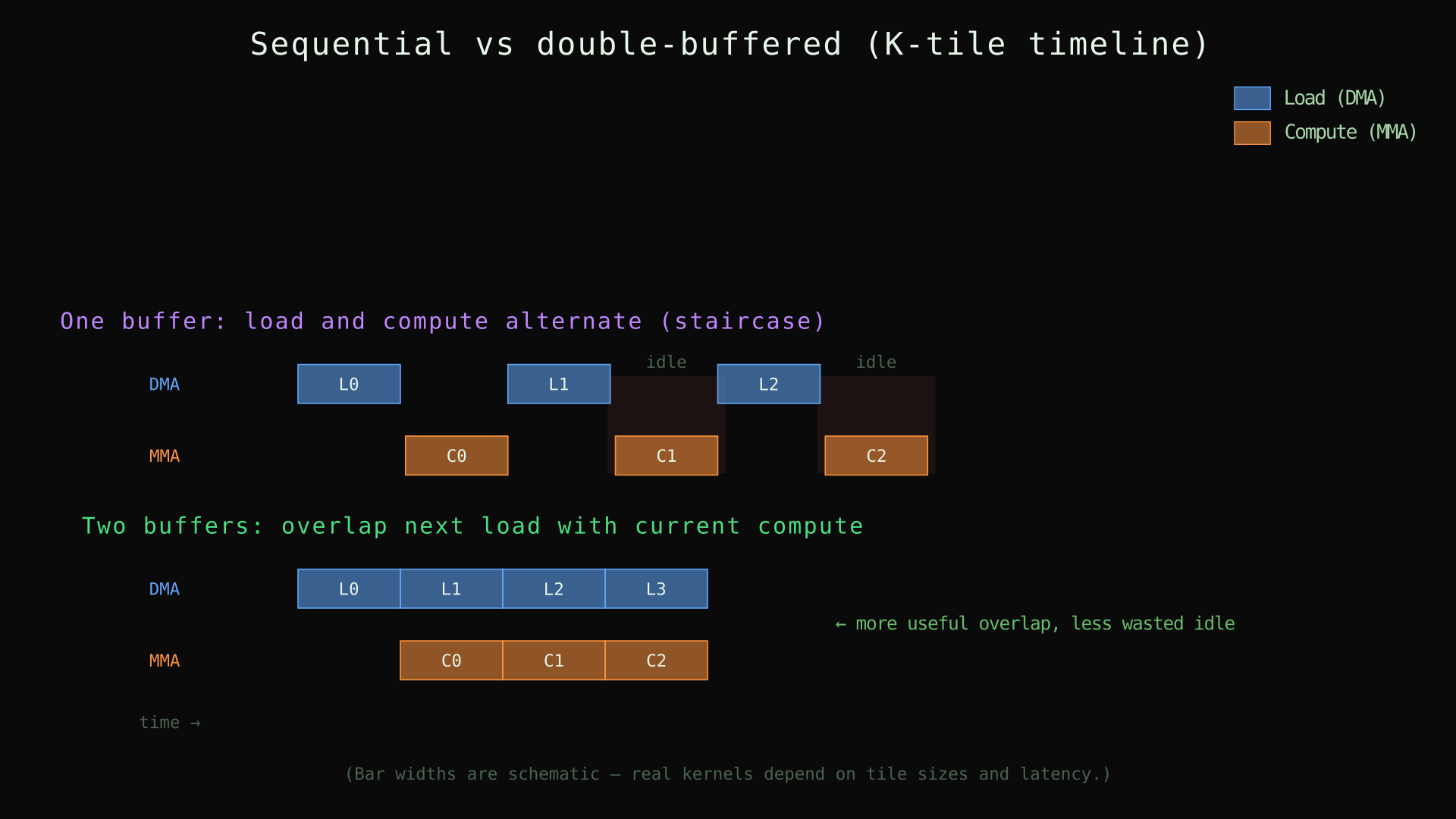
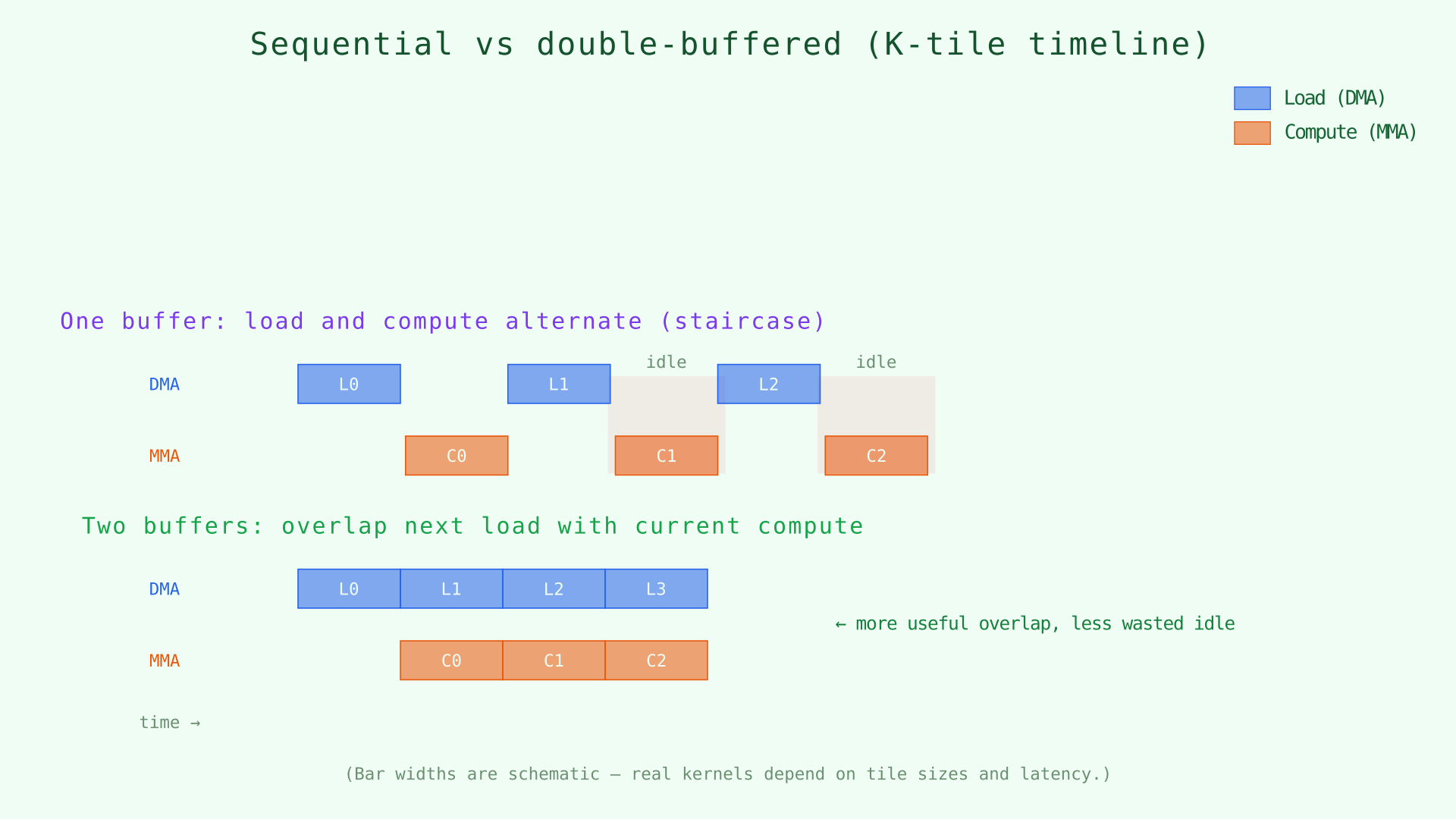
Give the K-loop two logical buffers. While the math drains buffer 0, DMA fills buffer 1 with the next tile. After the math step, swap the handles: what was "next" becomes "current," and the freed slot is ready for the following load.
Croqtile spells this with dma.copy.async (non-blocking copy), dma.any (a placeholder future), swap (exchange future handles), and a three-phase loop:
__co__ auto matmul(s32 [M, K] lhs, s32 [K, N] rhs) {
  s32 [lhs.span(0), rhs.span(1)] output;

  parallel {px, py} by [8, 16] : block
    parallel {qx, qy} by [16, 16] : thread {

    with tile_k in 16 {
      // Prologue: start loading tile 0
      lf0 = dma.copy.async lhs.chunkat(px, tile_k) => shared;
      rf0 = dma.copy.async rhs.chunkat(tile_k, py) => shared;

      // Placeholder futures for buffer 1
      lf1 = dma.any;
      rf1 = dma.any;

      // Steady state: load next tile while computing on current
      foreach tile_k(1:) {
        lf1 = dma.copy.async lhs.chunkat(px, tile_k) => shared;
        rf1 = dma.copy.async rhs.chunkat(tile_k, py) => shared;

        wait lf0, rf0;

        foreach k in [256 / #tile_k]
          output.at(px#qx, py#qy) += lf0.data.at(qx, k) * rf0.data.at(k, qy);

        swap(lf0, lf1);
        swap(rf0, rf1);
      }

      // Epilogue: compute on the last loaded tile
      foreach k in [256 / #tile_k]
        output.at(px#qx, py#qy) += lf0.data.at(qx, k) * rf0.data.at(k, qy);
    }
  }

  return output;
}
The three phases
Prologue. Issue loads for tile 0 into lf0/rf0. No compute yet — the first tile must land before anything can multiply it.
Steady state. For each subsequent tile: start loads into lf1/rf1, compute on lf0/rf0 from the previous iteration, then swap so names track the active buffers. New copies land in lf1/rf1 before the compute reads lf0/rf0, so you never read a buffer being overwritten.
Epilogue. After the last swap, lf0/rf0 hold the final tile; one more compute pass drains them.
swap: names, not bytes
swap(lf0, lf1) exchanges future handles — the Croqtile-level names that refer to buffers. Shared-memory contents stay where the hardware placed them; only the names rotate. In CUDA, the same idiom is often a ^ 1 buffer index or a boolean phase variable. For triple buffering, rotate(f0, f1, f2) cycles three handles in one step.
with tile_k in 16
Opens a scoped region and binds tile_k as a tile axis with extent 16. Inside the block, tile_k is the chunk index for chunkat along K, and #tile_k is 16.
dma.any: placeholder futures
dma.any creates a future that does not yet represent a transfer. It gives the type system something to swap against on the first steady-state iteration. Before any use of lf1.data, a real dma.copy has been assigned.
foreach tile_k(1:): sliced iteration
(1:) means tile indices 1, 2, ... through the end. Tile 0 was loaded in the prologue.
__co__ auto return type
__co__ auto matmul(...) lets the compiler infer the return type from return output.
This example uses s32 with scalar accumulation — a simplified style to isolate the swap mechanism. The same pattern applies to FP16/MMA kernels from Chapter 4.
Why you cannot "just overlap" without events
The swap pattern works because one thread group controls both loading and computing — it knows the order. Warp specialization (Chapter 5) puts them on different warpgroups with different program counters. They cannot share a swap schedule; they need a signaling mechanism.
The picture below contrasts a strict load-then-compute staircase with double-buffered overlap: same logical work, less idle time.
The full 1P1C event pipeline
This kernel combines inthreads.async (from Chapter 5) with event arrays to build a complete multi-stage pipeline. The producer and consumer run as separate concurrent programs, coordinated entirely through wait / trigger:
#define TILE_M 128
#define TILE_N 128
#define TILE_K 128
#define WARP_M 64
#define WARP_N 64
#define WARP_K 16
#define STAGES 2

__co__ void matmul(global f16 [M, K] lhs, global f16 [N, K] rhs, global f16 [M, N] output) {
  parallel {block_m, block_n} by [cdiv(M, WARP_M), cdiv(N, WARP_N)] : block {
    shared event full[STAGES], empty[STAGES];
    shared f16 [WARP_M, TILE_K] lhs_load_s[STAGES];
    shared f16 [WARP_N, TILE_K] rhs_load_s[STAGES];
    shared f16 [WARP_M, WARP_N] output_s;

    parallel p1 by 2 : group-4 {
      inthreads.async (p1 == 0) {
        foreach {iv_k} in [cdiv(K, TILE_K)] {
          stage = iv_k % STAGES;
          wait empty[stage];
          dma.copy lhs.subspan(WARP_M, TILE_K).at(block_m, iv_k)
            => lhs_load_s[stage];
          dma.copy rhs.chunkat(block_n, iv_k)
            => rhs_load_s[stage];
          trigger full[stage];
        }
      }

      inthreads.async (p1 == 1) {
        mc = mma.fill.f16 0.0f;
        foreach {s} in [STAGES]
          trigger empty[s];
        foreach {iv_k} in [cdiv(K, TILE_K)] {
          stage = iv_k % STAGES;
          wait full[stage];
          foreach {iv_warp} in [cdiv(TILE_K, WARP_K)] {
            ma = mma.load lhs_load_s[stage].chunkat(_, iv_warp);
            mb = mma.load rhs_load_s[stage].chunkat(_, iv_warp);
            mma.row.row mc, ma, mb;
          }
          mma.commit;
          trigger empty[stage];
        }
        mma.store mc, output_s;
        dma.copy output_s => output.subspan(WARP_M, WARP_N).at(block_m, block_n);
      }
    }
  }
}
Walking through the kernel
Ring index. stage = iv_k % STAGES maps the unbounded K iteration to a fixed number of physical buffer slots — double buffering generalized to N buffers.
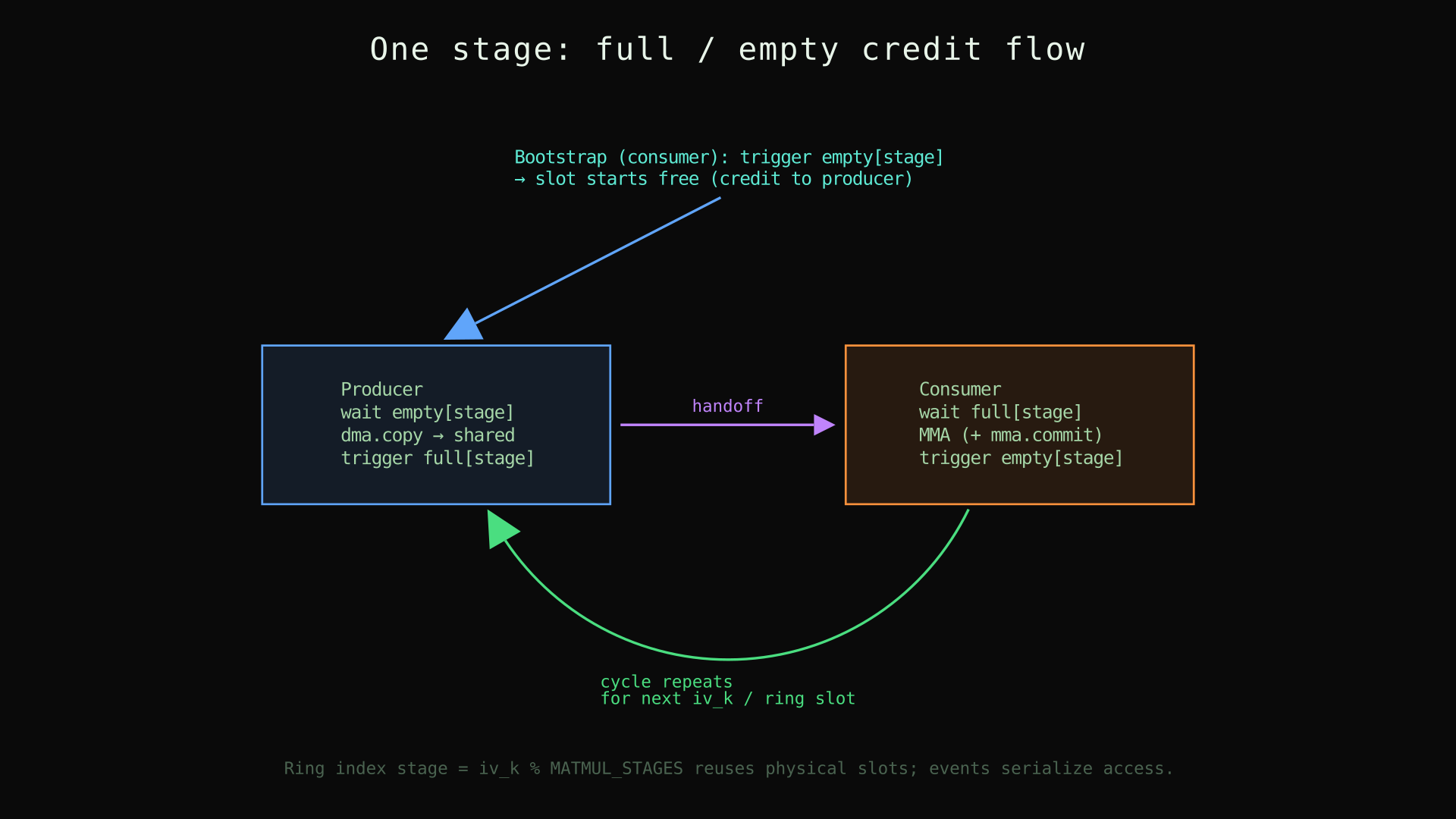
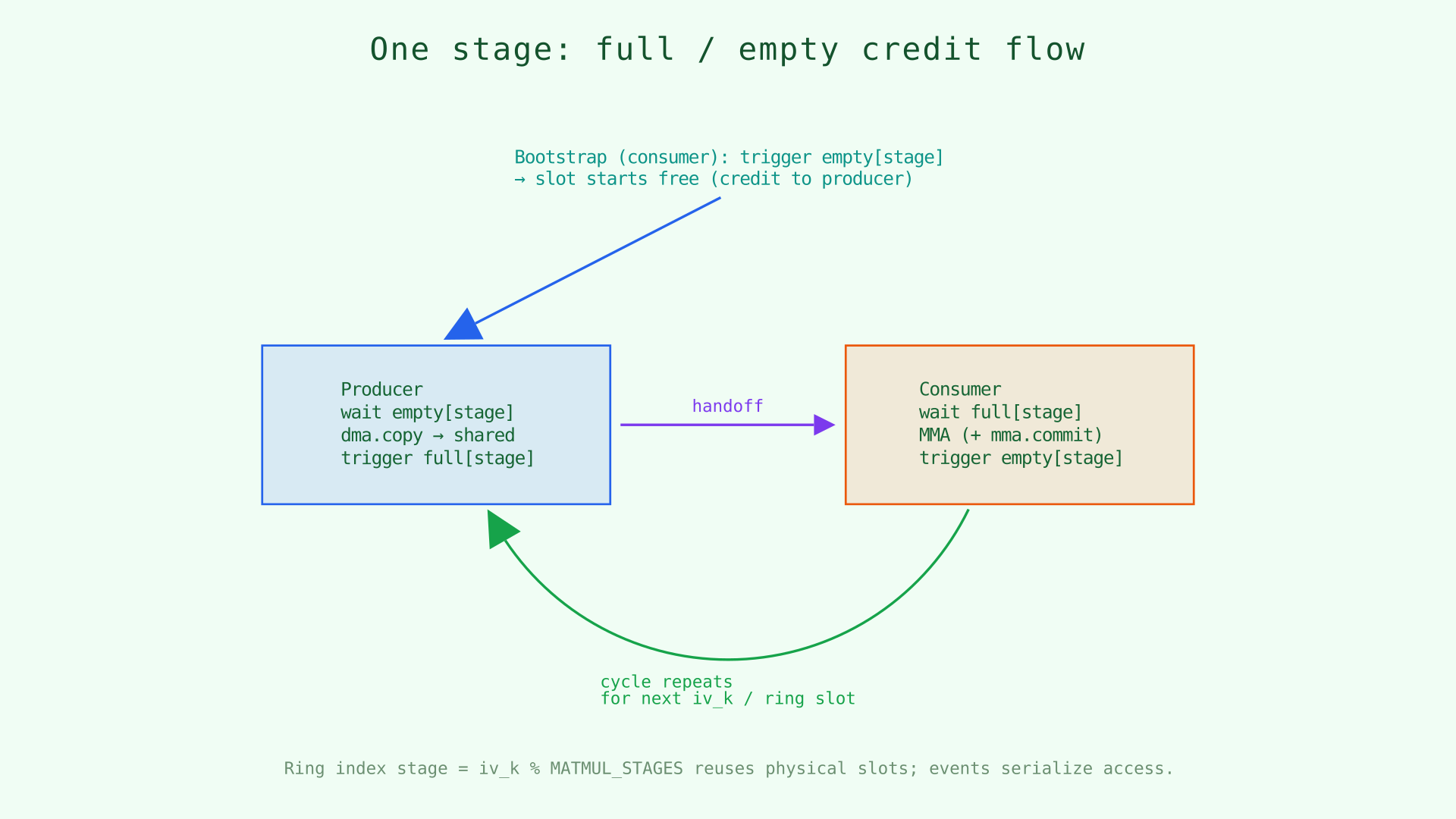
Producer path. For each iv_k, wait empty[stage] acquires a free slot. The dma.copy lines fill lhs_load_s / rhs_load_s at that stage. Then trigger full[stage] hands the slot to the consumer.
Consumer bootstrap. The loop foreach {s} in [STAGES] { trigger empty[s]; } runs before the K-loop so every stage starts with an empty credit. Without this, the producer blocks forever on its first wait empty — a deadlock.
Consumer path. Each iv_k: wait full[stage] blocks until the producer has filled that slot, then MMA over the tile, mma.commit, and trigger empty[stage] to release the slot for reuse.
mma.commit. Hopper WGMMA overlaps instruction issue and accumulation. mma.commit is the fence that completes one K-slab's contribution to mc before that stage's shared buffer may be reused. Omitting it risks reading stale data — the MMA might still be consuming operands when the producer overwrites the buffer.
Credit flow for one stage
The diagram matches the code: bootstrap grants empty credits; the producer waits on empty, fills, signals full; the consumer waits on full, computes, signals empty. When iv_k wraps modulo STAGES, the same physical stage re-enters the cycle.
Debugging tip
If something looks wrong after editing a pipeline, verify event order and trip counts before chasing MMA layout bugs: producer and consumer must use the same cdiv(K, TILE_K) loop bound, and too few stages shifts pressure to wait full when the consumer outruns the producer.
New syntax
| Syntax | Meaning |
|---|---|
dma.copy.async src => dst |
Non-blocking copy (returns immediately) |
dma.any |
Placeholder future (no transfer in flight yet) |
swap(f0, f1) |
Exchange two future handles without copying data |
rotate(f0, f1, f2) |
Cycle three future handles |
with tile_k in N { ... } |
Scoped tile axis binding with extent N |
foreach tile_k(1:) |
Iterate starting from index 1 |
mma.commit |
Fence between pipeline stages for WGMMA |
__co__ auto fn(...) |
Return type inferred from return statement |
Summary
| Pattern | Primitives used | When to use |
|---|---|---|
swap double buffering |
dma.any, swap |
Single thread group interleaving load and compute |
| 1P1C event pipeline | inthreads.async, shared event[], wait, trigger, mma.commit |
Separate producer/consumer warpgroups with multi-stage pipeline |
Both patterns achieve the same goal — overlapping memory and compute — but at different levels of complexity. Start with swap for simpler kernels; graduate to events when you need warp specialization.
The next chapter moves on to hardware-accelerated TMA, swizzled shared layouts, and view / from for irregular access — the same synchronization patterns from this chapter, with richer data movement primitives underneath.