Debug and Verbose: Printing, Assertions, and GDB
GPU kernels are opaque systems. Thousands of threads execute concurrently, shared memory is invisible from the host, and when results are wrong, there is no stack trace pointing to the bad line. This opacity is not unique to GPUs — any system where the programmer cannot directly observe intermediate state faces the same challenge: distributed systems (where is the lost message?), embedded firmware (which interrupt handler corrupted the register?), optimizing compilers (which pass broke the semantics?).
The universal debugging discipline is the same everywhere: systematically narrow the search space, from cheap checks to expensive ones. Start with static analysis and compile-time assertions (free, catches whole classes of bugs). Move to targeted runtime probes (cheap, localizes the problem). Resort to interactive debuggers only when the cheaper tools have narrowed the suspect list.
Croqtile provides tools at each level: compile-time shape printing (print!, println!) to verify tile dimensions without launching a kernel, runtime assertions (assert) for invariant checks, guarded device println for runtime inspection of specific threads, debug RTTI for cuda-gdb, and a verbose mode (-v) to see what the compiler is actually doing under the hood.
print! and println!: compile-time inspection
The bang variants (print!, println!) run at compile time, not at runtime. They print to the compiler's output and are useful for inspecting shapes, extents, and type information without launching a kernel:
__co__ void check_shapes(f32 [3, 2] b) {
  print!("shape of b: ");
  println!("b.span = ", b.span);
}
When you compile this file, the compiler emits:
shape of b: b.span = [3, 2]No GPU needed. String literals are concatenated ("wor" "ld!" becomes "world!"). Use print! / println! to verify that chunkat and subspan produce the tile sizes you expect before you spend time on a full kernel launch.
print and println: runtime device output
Without the bang, print and println emit device-side printf calls in the generated CUDA:
__co__ void inspect(s32 [4, 8] data) {
  foreach i in [data.span] {
    println("element ", i, " = ", data.at(i));
  }
}
Each call takes a comma-separated mix of string literals and expressions. The output order across threads is nondeterministic — GPU printf buffers are flushed asynchronously.
Guarding output. For a specific check, guard the print with a condition:
parallel {px, py} by [8, 16] : block
  parallel {qx, qy} by [16, 16] : thread {
    // ... compute ...
    if (px == 0 && py == 0 && qx == 3 && qy == 5) {
      println("partial sum = ", accum);
    }
  }
Without the guard you get one line per thread — thousands of lines for a large grid.
assert: runtime invariant checks
Croqtile's assert builtin checks an invariant at runtime and aborts the kernel with a message if it fails:
assert(stage < MATMUL_STAGES, "stage index out of bounds");On the device, this compiles to a printf of the message followed by an abort. Use assertions to catch index-out-of-range, null pointer, and other "this should never happen" conditions early.
Verbose mode: -v
Pass -v (or --verbose) to the compiler to see the external commands it invokes — which preprocessor, which code generator, which nvcc invocation:
croqtile kernel.co -v -o kernelThis is useful when you suspect the compiler is passing wrong flags to nvcc or when you need to see the exact generated file paths for manual inspection.
Runtime checks: -rtc
The compiler supports graduated runtime checking with -rtc (or --runtime-check):
croqtile kernel.co -rtc=high -o kernelLevels: none, entry (default), low, medium, high, all. Each level is a superset of the previous. Use high or all during development, none for production.
Debugging MMA-heavy kernels
When the wrong answer comes from a tensor-core path, suspect layout first — row versus column major, and whether the RHS is [N, K] versus [K, N] in memory. Then check indexing (which block_m, block_n, and K slice you attached with .at / chunkat). Then check async ordering if you introduced asynchronous copies or split producer and consumer warps.
A common mistake is mislabeling mma.row.row when the staged data is actually column-major, or using chunkat indices that do not align with the MMA tile geometry. If you use swizzled loads (tma.copy.swiz / mma.load.swiz), a mismatch shows up as a regular pattern in the error (e.g., every sixteenth element correct, the rest shifted).
Debug RTTI and cuda-gdb
When print / println is not enough, Croqtile supports debug RTTI (Runtime Type Information) that makes its types visible to cuda-gdb.
Compile with -g to enable debug symbols:
croqtile kernel.co -g -o kernel_debugThe generated code includes RTTI structs for Croqtile types:
| Croqtile type | GDB type | Fields |
|---|---|---|
| Shaped tensor ( s32 [M, N]) |
croq::rtti::spanned<int, 2> |
.span.data[] (dimensions), .stride.data[] (strides), .data (pointer) |
| Index tuple | croq::rtti::bounded_ituple<N> |
.data[] (values), .ub[] (upper bounds) |
| Integer tuple | croq::rtti::ituple<N> |
.data[] (values) |
| Multi-dim span | croq::rtti::mdspan<N> |
.data[] (extents) |
Example session:
cuda-gdb -q ./kernel_debug
(gdb) break my_kernel
(gdb) run
(gdb) ptype __dbg_lhs
type = struct croq::rtti::spanned<int, 2>
(gdb) print __dbg_lhs.span.data[0]
$1 = 32
(gdb) print __dbg_lhs.span.data[1]
$2 = 64
(gdb) print __dbg_lhs.data != 0
$3 = true
The __dbg_ prefix on variable names is generated by the compiler — it makes Croqtile variables visible alongside the generated C++ intermediates.
Putting it together
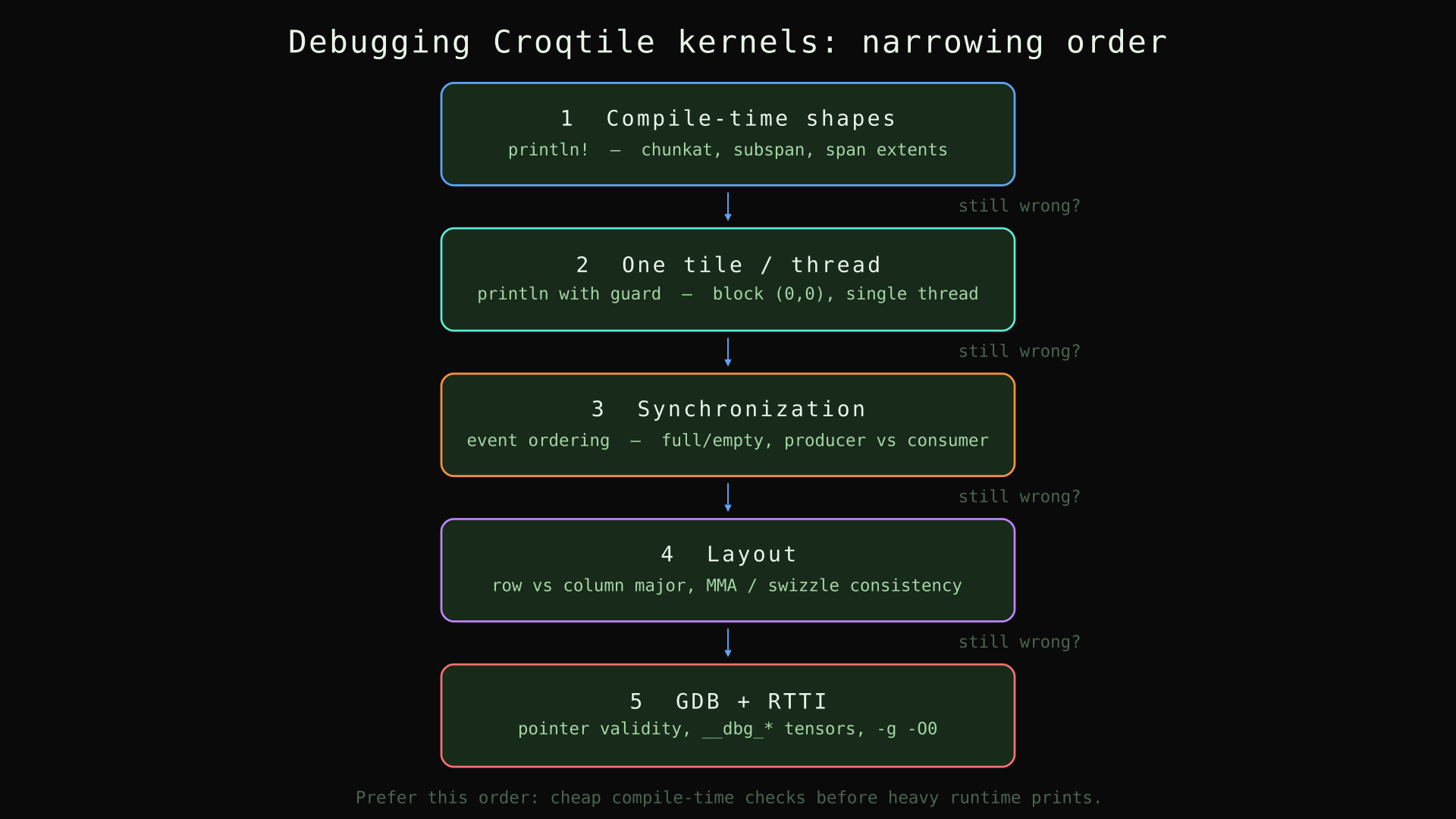
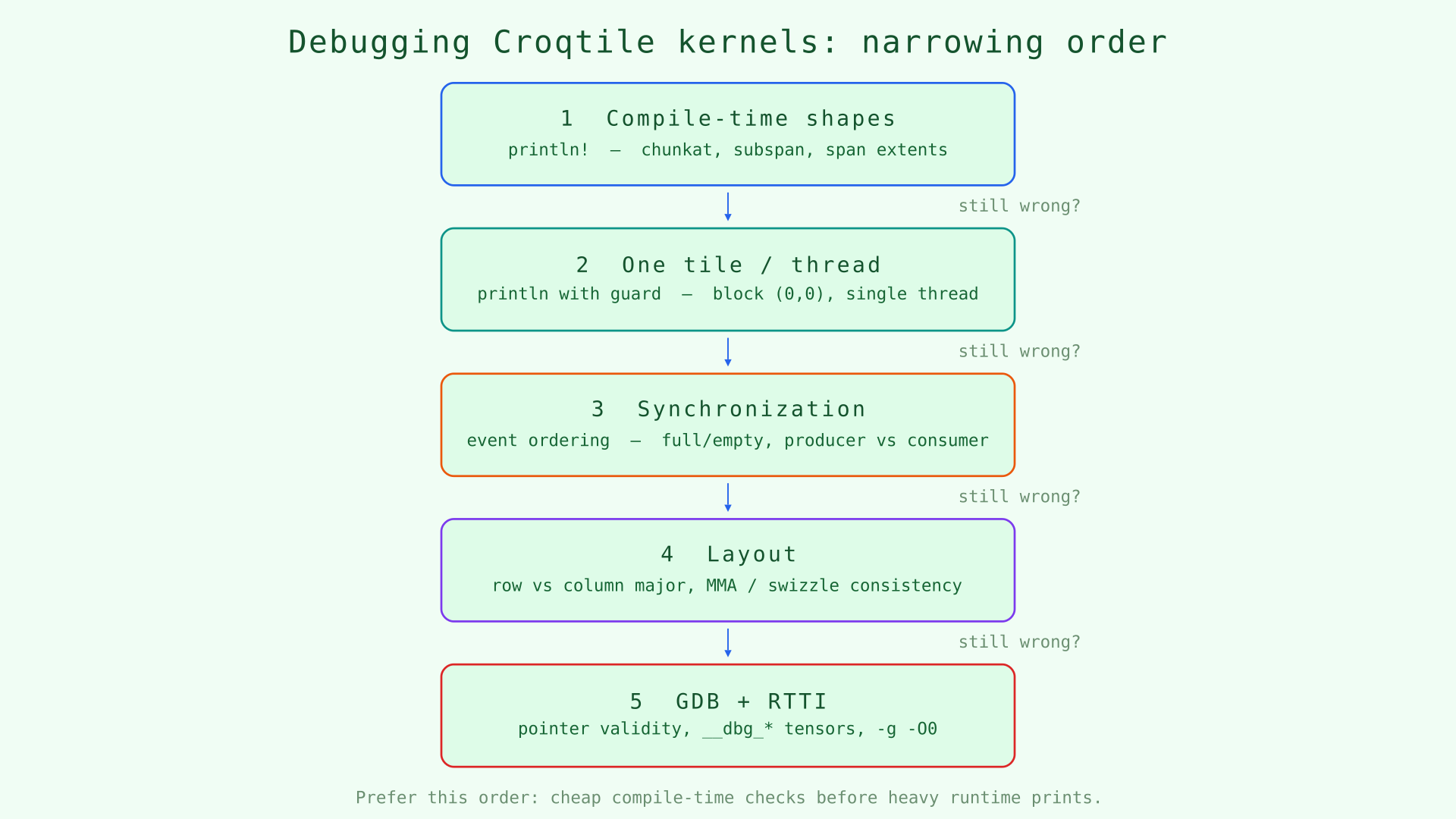
Work from cheap to expensive: println! (compile-time shapes) → guarded println on one tile (runtime values) → event/stage prints (synchronization) → pattern analysis (layout) → cuda-gdb (pointer bugs). Guard runtime prints behind #ifdef so they vanish in production:
#ifdef DEBUG_PRINT
  println("tile_k=", iv_k, " accum=", mc);
#endif
croqtile kernel.co -DDEBUG_PRINT -o kernel # debug build
croqtile kernel.co -o kernel # production buildSummary
| Tool | Level | Cost |
|---|---|---|
print! / println! |
Compile-time | Free — no kernel launch |
assert(expr, "msg") |
Runtime | Low — aborts on violation |
print / println |
Runtime | Medium — serialized printf |
-rtc=high |
Runtime | Medium — bounds checks |
-v / --verbose |
Compiler | Free — shows subprocess invocations |
-g + cuda-gdb + RTTI |
Runtime | High — debug symbols, no optimization |
You have learned the following concepts:
- simple element-wise addition in Croqtile (Chapter 1)
- data movement (Chapter 2)
- parallelism (Chapter 3)
- tensor cores (Chapter 4)
- control flow (Chapter 5)
- pipelining (Chapter 6)
- TMA (Chapter 7)
- C++ interop (Chapter 8)
- debugging (Chapter 9)
The next step is to open a benchmark kernel from the croqtile/benchmark/ directory, map its regions to the chapters here, change one constant, rebuild, and measure.